AI Is Not One Thing: A Plain-English Guide to Generative, Predictive, Conversational, and Agentic AI
September 22, 2026 · 18 min read · Gigi
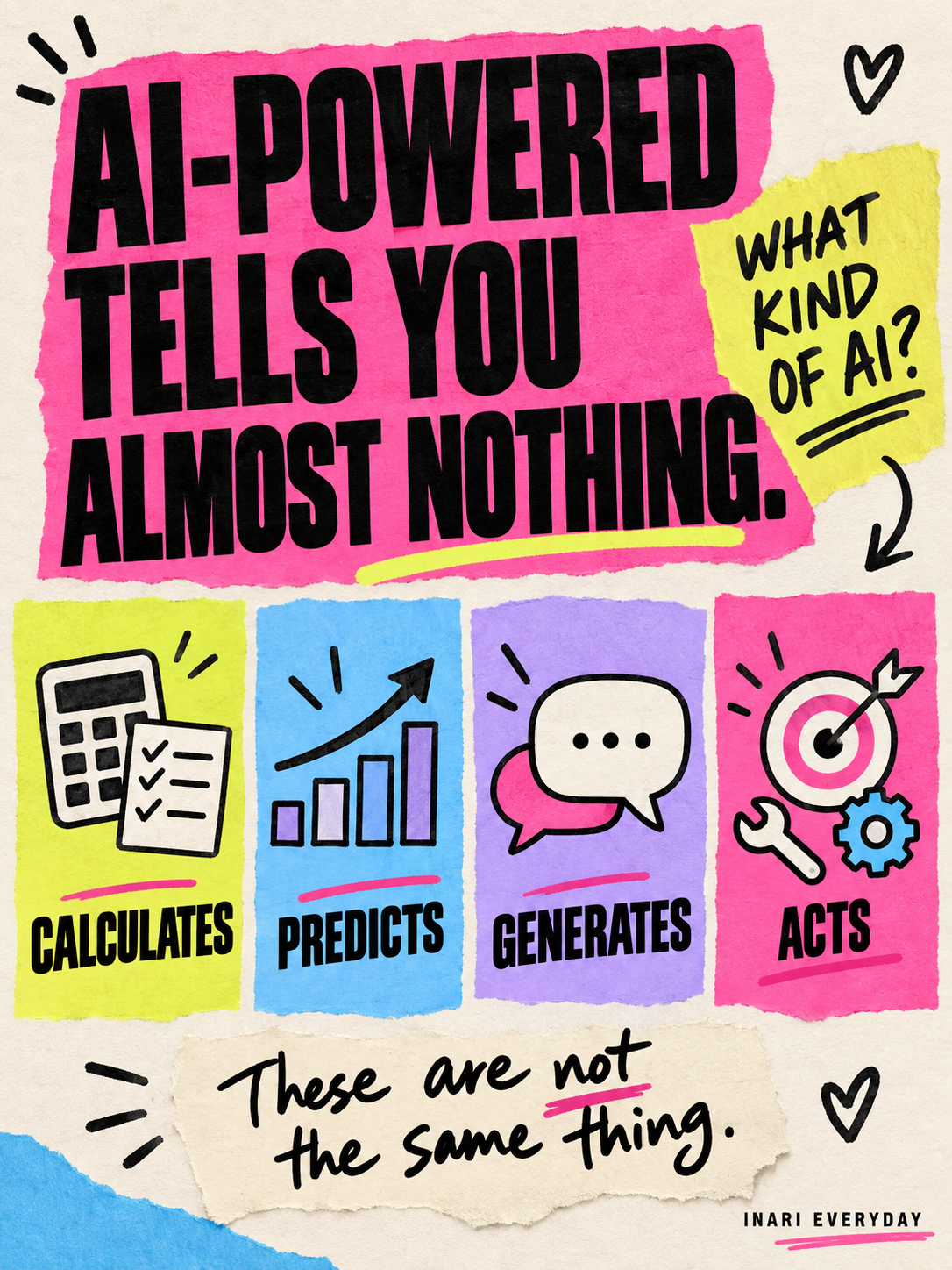
Artificial intelligence has developed a vocabulary problem.
Almost everything is now described as “AI-powered.” A chatbot is AI. A photo generator is AI. A fraud-detection model is AI. A website that recommends products is AI. A tool that writes an email is AI. A system that reads the email, checks the order, drafts a reply, updates the customer record, and schedules a follow-up is also AI.
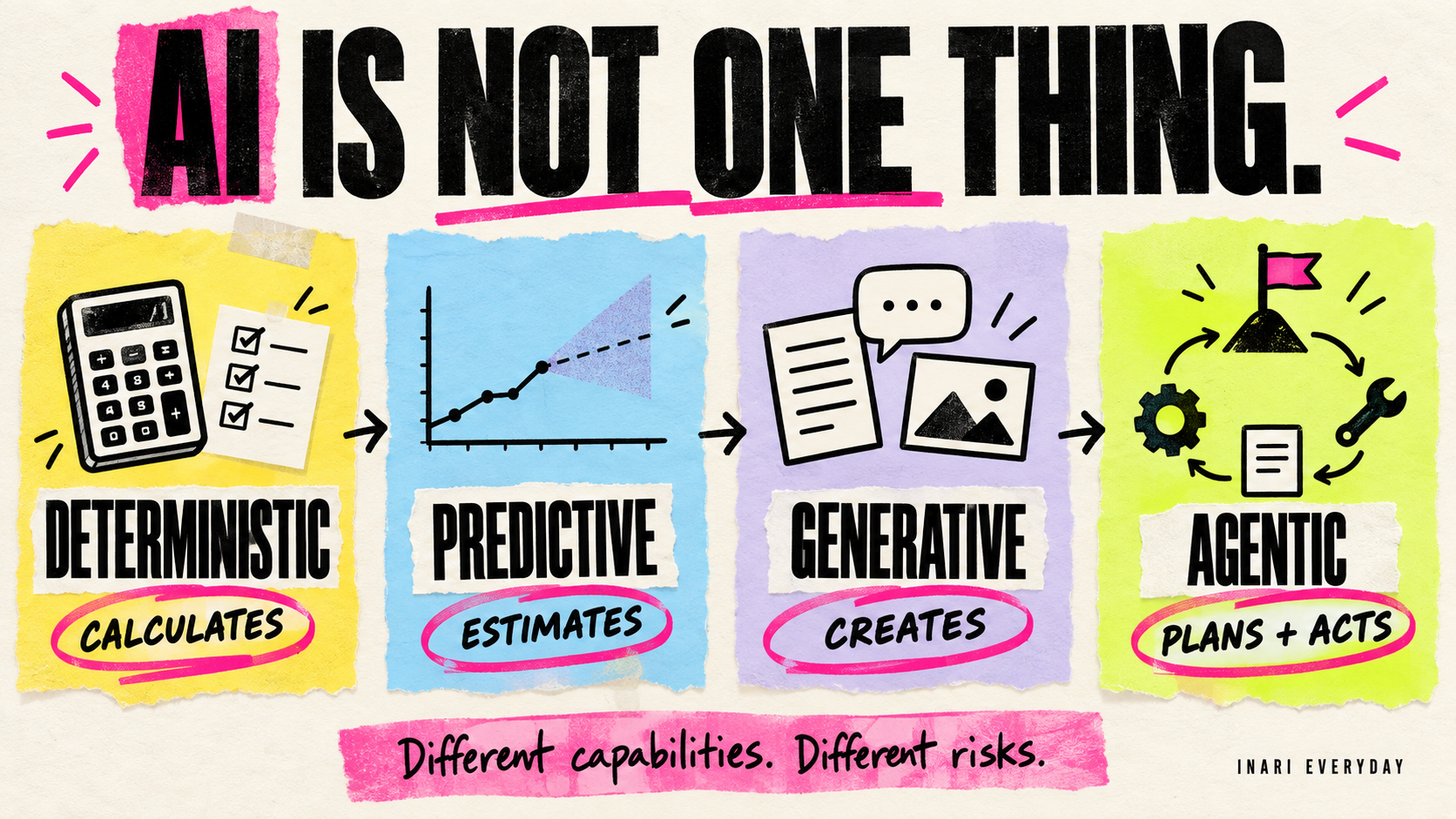
Those systems do not have the same capabilities, risks, or level of authority.
Calling all of them “AI” is technically convenient and practically useless.
It is a little like calling a calculator, a camera, a forklift, and an employee “equipment.” The label is not necessarily wrong. It just does not tell you what the thing does—or whether you should let it near your customer list, bank account, inventory, or pricing.
For a small business, the important question is not:
“Does this product use AI?”
The useful questions are:
- What kind of AI is it?
- What information can it access?
- Does it generate, predict, recommend, or act?
- Does it remember anything?
- Can it use outside tools?
- Can it change real business records?
- Does a human approve important actions?
- Can it explain where an answer came from?
- What happens when the AI is wrong or unavailable?
This guide explains the major types of AI in plain English, then looks underneath the marketing label at the layers that turn a model into a functioning AI product.
First: “AI” Can Describe a Capability, a Model, or an Entire System
One reason AI terminology becomes confusing is that people use the same word for different levels of technology.
“AI” may refer to:
- A field of technology concerned with machines performing tasks associated with intelligence.
- A model trained to recognize patterns, make predictions, or generate content.
- A capability such as image recognition, language generation, or forecasting.
- A complete product containing models, databases, rules, tools, permissions, interfaces, and human controls.
The model is not the whole product.
A large language model may generate the words in an answer, but other layers determine which data it receives, whether it can search a database, whether it remembers prior information, which actions it can take, and whether a human must approve the result.
This is why two products built with similar foundation models can behave completely differently. One may be a writing assistant. Another may be an agent connected to email, inventory, and customer records. The language model might be related, but the surrounding system changes the capability and the risk.
Type 1: Rules-Based and Deterministic Systems
Let us begin with the category that is frequently marketed as AI even when it may not be machine learning at all.
A rules-based or deterministic system follows explicit instructions written by people.
For example:
- If margin is below 20%, show a danger warning.
- If inventory falls below the reorder point, create an alert.
- If an invoice is overdue by 30 days, flag the account.
- If materials cost $8, labor costs $12, and fees cost $3, total cost is $23.
The same validated inputs should produce the same result.
This kind of software is not glamorous, but it is often exactly what a business needs. Arithmetic, tax rules, permission checks, inventory deductions, and other operations with objectively correct outcomes should not be handed to a language model merely because AI is fashionable.
Where deterministic systems are useful
- Financial calculations
- Product costing
- Inventory arithmetic
- Eligibility rules
- Compliance checks
- Workflow triggers
- Access control
- Required business logic
The limitation
A deterministic system is only as flexible as its programmed rules. It does not naturally interpret messy language, infer intent, or generate a nuanced explanation.
Why it still belongs in an AI article
Reliable AI products often combine probabilistic AI with deterministic software. The deterministic layer handles facts, arithmetic, permissions, and non-negotiable rules. AI handles language, classification, extraction, or interpretation.
At Inari, for example, core product-cost calculations are deterministic. AI may help collect information or explain what the results mean, but it does not get to improvise the arithmetic.
That is not “less AI.” It is better system design.
Type 2: Predictive AI
Predictive AI examines patterns in existing data to estimate what is likely to happen or how something should be classified.
Examples include:
- Predicting whether a transaction may be fraudulent
- Forecasting demand for a product
- Estimating customer churn
- Scoring a sales lead
- Predicting equipment failure
- Classifying an email as spam
- Estimating delivery times
Predictive systems generally produce a probability, score, category, or forecast rather than a new piece of creative content.
A small-business example
A maker has three years of order history. A predictive model could look for seasonal patterns and estimate how many units may sell during the holiday period.
That forecast is not a promise. It is an estimate based on patterns, available data, and assumptions. A viral post, supply disruption, economic change, or sudden platform ban can make yesterday's pattern useless tomorrow.
The key risk
Predictions can look more certain than they are. A number such as “82% likely” feels precise even when the underlying data are incomplete, biased, or no longer relevant.
Good predictive AI should communicate confidence, data limitations, and the cost of a wrong prediction.
Type 3: Classification and Recognition AI
Classification systems identify what something is or which category it belongs to.
They may:
- Recognize an object in an image
- Identify the language of a message
- Categorize an expense
- Detect whether a review expresses positive or negative sentiment
- Route a support request to the correct department
- Flag content that may violate a policy
Computer vision is a prominent form of recognition AI. It allows systems to analyze images and video—for example, reading a shipping label, detecting a manufacturing defect, or identifying a product in a photograph.
Speech recognition converts spoken audio into text. Optical character recognition extracts text from images or documents. These capabilities may be embedded inside a larger AI workflow without the user ever seeing them as separate products.
The key risk
Classification errors are not evenly distributed. A system may work well on the examples represented in its training data and poorly on unusual products, languages, accents, lighting conditions, cultures, or business contexts.
The question is not only “How accurate is it?” but “Accurate for whom, under which conditions, and what happens when it is wrong?”
Type 4: Recommendation Systems
Recommendation systems rank or suggest options based on patterns in user behavior, item characteristics, context, or similarity.
They power familiar experiences such as:
- “Customers also bought” suggestions
- Music and video recommendations
- Marketplace search rankings
- Product recommendations
- Suggested next actions
- Personalized content feeds
Collaborative filtering, one common recommendation technique, uses relationships between users and items to identify likely preferences. Other systems rely on product attributes, context, business rules, or combinations of methods.
Recommendation is not decision
A system can recommend an action without having authority to take it.
That distinction is fundamental.
“You may want to reorder this material” is not the same as placing the order.
“This product may be underpriced” is not the same as changing the price.
“This customer may be likely to leave” is not the same as automatically sending them an offer.
Responsible products make the boundary visible.
Type 5: Generative AI
Generative AI creates new synthetic content based on patterns learned from existing data.
NIST defines generative AI as a class of models that emulate the structure and characteristics of input data to generate content such as text, images, audio, video, and other digital material.
Generative AI can produce:
- Text
- Images
- Audio
- Video
- Software code
- Designs
- Summaries
- Translations
- Synthetic data
Large language models are a form of generative AI designed to work with language. They generate likely sequences of tokens—the units into which text is divided—based on the prompt, context, and patterns learned during training.
What generative AI is good at
- Drafting and rewriting
- Summarizing
- Brainstorming
- Translating
- Extracting possible structure from messy text
- Explaining information in different tones or levels of complexity
- Generating creative variations
What generative AI is not automatically good at
- Exact arithmetic
- Guaranteed factual accuracy
- Knowing private or current information it has not been given
- Following unstated business rules
- Understanding consequences outside its available context
- Making high-stakes decisions without oversight
Generative models can produce fluent nonsense. The sentence may be polished, confident, and entirely wrong.
That is why a strong business system does not confuse “sounds intelligent” with “is verified.”
Type 6: Conversational AI
Conversational AI is designed to interact through natural language, typically in chat or voice form.
It may use:
- Language models
- Intent detection
- Retrieval from a knowledge base
- Speech recognition
- Text-to-speech
- Business rules
- User profiles or conversation history
A traditional chatbot may follow a decision tree. A modern conversational assistant may generate flexible responses using a large language model. Both are conversational interfaces, but their underlying capabilities differ.
A chat interface does not prove an agent exists
This is a common source of confusion.
If a user types a question and receives a natural-language response, the system is conversational. It is not necessarily agentic.
A chatbot that explains your return policy is not the same as a system that checks the order, confirms eligibility, requests approval, issues the refund, updates inventory, and records the event.
Conversation describes how a user interacts with the system. Agency describes what the system can do.
Type 7: Retrieval-Augmented AI
A language model does not automatically know a company's current private information. Retrieval-augmented generation—often shortened to RAG—helps by finding relevant information from an approved source and supplying it to the model as context.
The system might retrieve:
- A policy document
- Product records
- Customer-support articles
- A user's own notes
- Inventory information
- Current pricing
- A database result
The model then uses that retrieved context to answer.
Why retrieval matters
Without retrieval, a model may rely on general training patterns or whatever the user included in the prompt. With retrieval, the response can be grounded in current, business-specific information.
Retrieval does not eliminate hallucination
The model can still misunderstand the source, combine unrelated passages, omit an important exception, or state an inference too confidently.
Good systems show sources, restrict retrieval to authorized information, evaluate groundedness, and fall back when the evidence is insufficient.
Type 8: Workflow Automation
Automation moves work through predetermined steps.
For example:
- A new order arrives.
- The system sends a confirmation.
- Inventory is reduced.
- A production task is created.
- The order is added to a shipping queue.
This may contain AI at one or more steps, but the workflow itself can be deterministic.
AI-assisted workflow
An AI-assisted workflow might classify the order, extract a customization request, or draft a message—but still follow a predefined path.
Why the distinction matters
People frequently label any multi-step automation “agentic.” But a workflow follows paths designed in advance. An agent has more discretion to decide how to pursue the goal.
Anthropic makes a useful distinction: workflows use predefined code paths to orchestrate models and tools, while agents dynamically direct their own process and tool use.
Neither is universally better.
If the work can be handled safely with a predictable workflow, giving an AI more freedom may add risk without adding value.
Type 9: Agentic AI
Agentic AI refers to systems that use AI models to pursue goals, make bounded decisions, use tools, and complete multi-step work with some degree of autonomy.
OpenAI describes agents as applications that can plan, call tools, maintain enough state, and complete multi-step tasks. Anthropic offers an even plainer formulation: agents are language models autonomously using tools in a loop.
An agent typically has:
- A goal
- Instructions
- Context
- A model capable of reasoning about the next step
- Tools it is allowed to use
- State or memory
- A loop for observing results and choosing what to do next
- Guardrails and permissions
- A stopping condition
A simple agent example
Suppose a small business asks:
“Find every product whose margin fell below 35% this month and prepare a review.”
An agent might:
- Query product and cost records.
- Identify products below the threshold.
- Retrieve recent material-price changes.
- Check whether fees or labor assumptions changed.
- Create a summary for each affected product.
- Recommend possible actions.
- Ask the owner which changes, if any, should be made.
The agent is not simply generating a paragraph. It is choosing and executing steps toward a goal.
Agentic does not mean unrestricted
A well-designed agent should not receive unlimited authority.
It can be allowed to read product records but forbidden to alter them. It can draft a customer reply but require approval before sending. It can prepare a purchase order but not place the order. It can calculate possible production schedules without committing the team to one.
Agency should be bounded by the consequences of the action.
Agentic AI is probabilistic
Traditional workflows are normally deterministic: developers specify the sequence of steps. Agents use models to interpret context and decide how to move through the work within their instructions and tools.
That flexibility is the advantage—and the risk.
An agent can adapt when the path is not known in advance. It can also choose the wrong path, misuse a tool, misunderstand the goal, or continue when it should stop.
Type 10: Multi-Agent Systems
A multi-agent system uses more than one specialized agent to complete work.
One agent might plan. Another researches. Another analyzes data. Another verifies evidence. A coordinating agent combines the results.
Multi-agent systems can help when tasks are genuinely broad, parallel, or specialized. They can also create spectacularly expensive organizational theater inside a computer.
Five agents debating a task does not automatically produce a better answer than one well-designed workflow.
When multiple agents may help
- Work can be divided into independent parallel tasks
- Different tools or specialized instructions are required
- A reviewer agent can evaluate another agent's output
- The problem is too broad for one context window
When they may not help
- The task is simple
- Steps must occur in a strict sequence
- The agents lack independent evidence
- Errors can compound across handoffs
- Cost and latency matter
- Nobody can explain which agent is responsible for the final result
More agents are not the same as more intelligence.
The Layers of an AI System
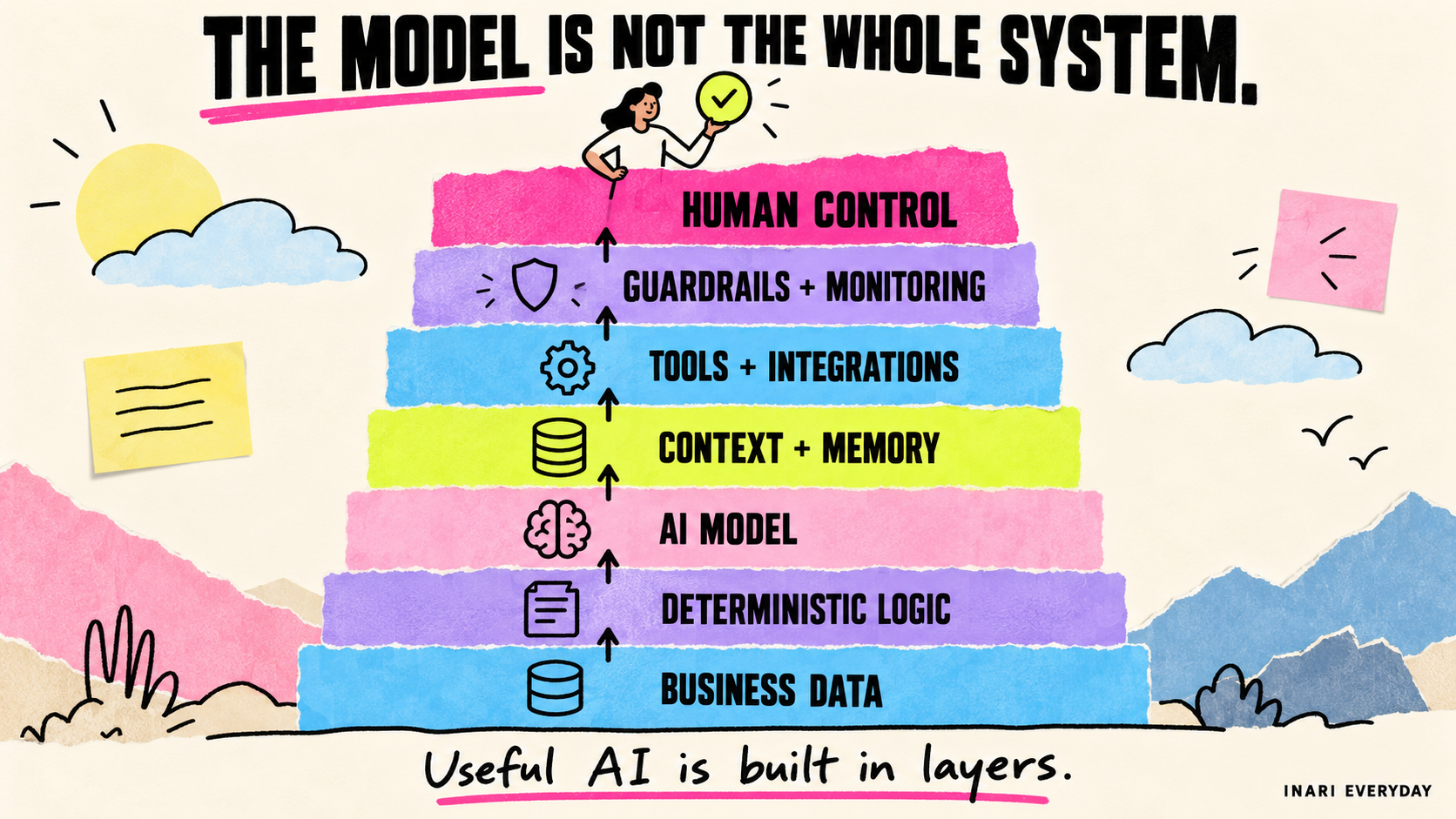
The “type” of AI explains the kind of capability involved. The “layers” explain how a usable system is assembled.
There is no single universal layer diagram, but most modern AI products contain several of the following.
Layer 1: The User Experience
This is what the person sees:
- A chat box
- A dashboard
- A form
- A voice interface
- A button that says “Analyze”
- A recommendation card
- An approval screen
The interface shapes expectations. A friendly chat box can make a system feel more capable or trustworthy than it is. Good design clearly communicates whether the system is drafting, recommending, predicting, or acting.
Layer 2: Business Data
AI needs context.
For a small product business, this may include:
- Products
- Materials
- Suppliers
- Labor assumptions
- Orders
- Fees
- Prices
- Inventory
- Production records
- Customer communications
Data quality limits every layer above it. AI cannot rescue an operation built on missing costs, inconsistent units, duplicated products, and five conflicting spreadsheets without first helping resolve those problems.
Garbage in, glittering paragraph out, still garbage.
Layer 3: Deterministic Business Logic
This layer performs calculations and enforces rules that should not change according to the model's mood.
It may calculate:
- Unit cost
- Margin
- Break-even price
- Inventory deductions
- Fee totals
- Tax or eligibility rules
- Permission checks
In a trustworthy system, the model does not quietly override this layer.
Layer 4: The AI Model
The model supplies capabilities such as language generation, classification, vision, prediction, or reasoning.
Different models may be chosen for different work. A small, fast model may classify support requests. A larger model may analyze a complex operational question. An image model may inspect a photograph. A forecasting model may estimate demand.
Using the largest possible model for every task is not a strategy. It is an invoice.
Layer 5: Context and Retrieval
This layer selects the information the model receives for the current task.
It may include:
- The user's request
- Relevant business records
- Policy documents
- Recent events
- Retrieved help content
- Calculated results
- Tool outputs
Context engineering is the discipline of providing the right information, in the right form, at the right time—without flooding the model with irrelevant data.
Layer 6: Memory and State
Memory allows the system to carry useful information across steps or sessions.
Memory may be:
- Short-term state: what has happened during the current task
- Conversation history: what the user and system already discussed
- Structured business memory: stored facts such as materials, products, targets, and preferences
- Long-term learned preferences: patterns the system has permission to retain
Memory is useful, but it creates privacy and correction problems. Users should know what is stored, be able to update incorrect information, and understand whether deletion is possible.
Inari's concept of memory is not “the bot remembers your favorite emoji.” It is that a material entered once can remain connected to every product using it, allowing later cost changes to become operationally meaningful.
Layer 7: Tools and Integrations
Tools allow an AI system to do more than generate language.
A tool might:
- Query a database
- Search approved documents
- Read orders from Etsy
- Create a report
- Draft an email
- Update a task
- Calculate a scenario
- Call a shipping service
Tool access creates capability. It also creates risk.
An agent that can read inventory is different from one that can alter inventory. An agent that can draft a refund is different from one that can move money.
Permissions must be designed at the tool level, not buried in a vague promise that the AI is “safe.”
Layer 8: Orchestration
Orchestration controls how models, tools, rules, and data work together.
It may determine:
- Which model handles the task
- Which tool is called
- What happens after a tool returns an error
- Whether steps run sequentially or in parallel
- When the system asks a human
- When the process stops
- Whether a reviewer checks the result
In a workflow, orchestration mostly follows predefined paths. In an agentic system, the model may make more of these choices dynamically.
Layer 9: Permissions and Human Approval
This layer answers the most important operational question:
What is the system allowed to do without asking?
Possible levels include:
- Observe: read authorized information.
- Explain: summarize or interpret it.
- Recommend: propose an action.
- Prepare: create a draft or staged change.
- Act with approval: execute only after a human confirms.
- Act autonomously: execute within predefined boundaries.
Most consequential small-business actions should not jump directly from observation to autonomous execution.
Layer 10: Guardrails, Monitoring, and Evaluation
Guardrails restrict unsafe or inappropriate behavior. Monitoring records what the system did. Evaluation tests whether the system performs acceptably before and after release.
This layer may include:
- Input validation
- Output checks
- Access controls
- Tool restrictions
- Approval requirements
- Audit logs
- Rate limits
- Failure alerts
- Test datasets
- Accuracy and groundedness evaluations
- Procedures for disabling a model, tool, or workflow
An AI product is not responsible merely because its homepage uses the phrase “responsible AI.” Human control has to be designed into the system. It needs controls, evidence, and a recovery plan.
Why These Distinctions Matter for Small Businesses
Small businesses are frequently sold capabilities they do not need and denied explanations they absolutely do.
A maker may think she needs an “AI agent” when she actually needs a reliable calculator and a clear recommendation. Another may buy a chatbot when the real problem is disconnected inventory. A third may enable autonomous email because the product never clearly explained the difference between drafting and sending.
Before adopting an AI tool, ask:
- Is it generating, predicting, recommending, or acting?
- What is deterministic and what is probabilistic?
- Which business data can it access?
- Does it use my data to train anything?
- What does it remember?
- Which tools can it call?
- Are integrations read-only or read-write?
- Which actions require approval?
- Can I inspect the evidence?
- Can I correct the record?
- Can I revoke access?
- Is there an audit log?
- Can the AI feature be disabled without losing my core data?
- Is a human available when the system fails?
If a vendor cannot answer those questions, “AI-powered” is not an explanation.
It is decorative fog.
How Inari Uses Different Layers of AI
Inari Everyday is being built as operational intelligence for small makers and artisans—not as one giant language model wearing a calculator costume.
Different tasks belong to different layers.
Deterministic calculation
Product cost, profit, margin, break-even values, fees, and related arithmetic are calculated by a deterministic engine.
Generative explanation
AI can translate structured results into clearer, more approachable language without changing the math.
Structured memory
Products, materials, suppliers, components, owner defaults, and business relationships remain connected so information can be reused and changes can have context.
Conversational intake
The Quickstart experience allows a maker to describe a product naturally. AI can extract possible materials, quantities, costs, and labor information. The maker reviews and corrects the interpretation before it is written to the structured record.
Recommendation with evidence
Inari can surface what may need attention, but “Show Me Why” connects the observation to the input, calculated value, target, and consequence.
Scenario modeling
“What If” tools let the maker test changes to price, labor, materials, waste, fees, and yield without altering the real product until she chooses to make the scenario real.
Bounded integrations
Inari's Etsy integration is read-only. Information can come into the operational system, but the AI does not post changes back to the shop.
Human authority
AI recommends. The maker decides.
The goal is not to automate the human out of the business. It is to give one real human access to capabilities that previously required several specialists—while keeping consequential decisions visible, explainable, and interruptible.
The Best AI System Is Not Necessarily the Most Autonomous
Technology companies have created a strange hierarchy in which more autonomy is automatically presented as more advanced.
But the most autonomous system is not always the most useful system.
If a task requires exact arithmetic, use exact arithmetic.
If it requires classification, use classification.
If it requires creative language, use generative AI.
If it requires a fixed sequence, use a workflow.
If it requires adapting across uncertain steps, an agent may be appropriate.
If the action can harm a customer, move money, change a price, expose private information, or disrupt production, require meaningful control.
The sophisticated choice is not “put an agent everywhere.”
The sophisticated choice is matching the capability and authority to the actual job.
The Real AI Question
AI is not one thing.
It is a collection of models, methods, interfaces, and systems that can recognize, classify, predict, generate, recommend, retrieve, plan, and act.
The label tells you almost nothing by itself.
The real question is:
What has this system been designed to do—and what has it been given permission to do to me, my customers, and my business?
For small makers and artisans, useful AI should create capacity without creating mystery. It should explain its role, respect boundaries, preserve human authority, and leave the business functional when the clever layer has a bad day.
You do not need the most agentic, autonomous, futuristic tool available.
You need the right kind of intelligence in the right layer, doing the right job, with a human still firmly in charge.
You make the things. Inari helps run the business.
What Does Your Work Really Pay You?
Seven quick questions. Honest arithmetic. Free. No gentle lies about your margins.
Run the True Cost CheckDon't stop here
Inari vs. Stocksmith vs. Wix Harmony: Which Small-Business Platform Is Right for Makers in 2026?
Three tools, three very different jobs. An honest comparison of Wix Harmony, Stocksmith (formerly Craftybase), and Inari for makers choosing what their business actually needs.
AI Did Not Steal Five Jobs From My Small Business. Those Jobs Never Existed.
Does AI replace small-business jobs? For many tiny companies, the departments never existed. AI can create capacity where there was none.
California Is Exploring an AI “Kill Switch.” Here’s How Inari Is Building for Human Control Now.
California is exploring an AI kill switch. Here is how Inari builds human control, explainability, approval, and graceful degradation into AI for small business.