AI Did Not Steal Five Jobs From My Small Business. Those Jobs Never Existed.
September 19, 2026 · 8 min read · Gigi
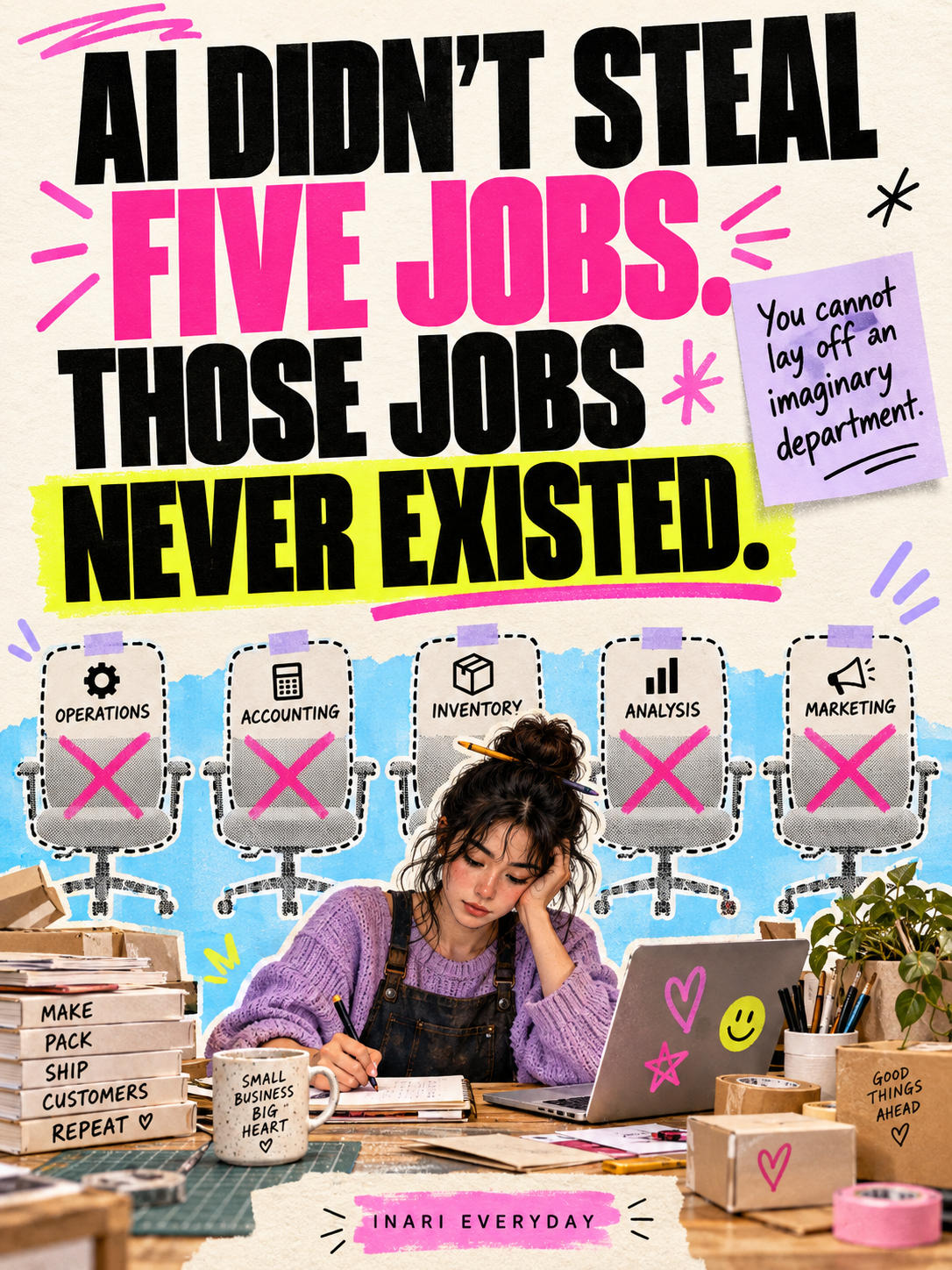
There is a particular argument about artificial intelligence that sounds morally serious until you apply it to an actual small business.
It goes something like this:
“If Inari gives one small business the capabilities of a five-person operations team, that means five human beings lost their jobs.”
No.
It means a five-person operations team was never remotely within the budget.
There was no department. There were no job listings. No candidates were interviewed. Nobody had a desk, a salary, or a dental plan. The “team” existed only as a list of work the founder desperately needed done and could not afford to pay five separate specialists to do.
AI did not march into the building and fire accounting, operations, inventory, marketing, and data analysis.
There was no building.
There was one exhausted person at a kitchen table doing all five jobs badly at 1:00 a.m.
That distinction matters.
You Cannot Lay Off an Imaginary Department
Inari Everyday is being built for very small makers and artisans—often businesses run by one, two, or three people.
These businesses need many of the same functions as larger companies. They need to understand product costs, monitor margins, organize materials, plan production, track sales, interpret business data, and decide what requires attention next.
What they usually do not have is the money to hire:
- An operations manager
- A cost accountant
- An inventory planner
- A business analyst
- A marketing strategist
Pretending that every useful AI feature replaces a full-time human in one of those roles is economically absurd.
A maker earning enough to support herself and perhaps one assistant was not about to hire a five-person back office. Without software, the likely alternatives were not five lovely salaried professionals doing excellent work. They were:
- The founder doing it herself after production hours
- A partner or family member helping without proper pay
- A spreadsheet held together by color coding and fear
- A stack of receipts waiting for “later”
- Important work being postponed indefinitely
- Decisions being made with incomplete information
- The business staying smaller, shakier, and less profitable than it could be
That is the honest comparison.
For very small businesses, AI is often not replacing labor. It is making previously inaccessible capability available for the first time.
The Fallacy Is Comparing Reality to a Fictional Payroll
The anti-AI jobs argument often begins with a fictional version of the business.
In that imaginary company, every operational need would otherwise be handled by a properly paid human specialist. Introduce AI, and the software appears to remove that person from the payroll.
But the real business never had that payroll.
If a $77 software subscription helps a maker understand information that would otherwise require thousands of dollars in professional labor, it does not follow that the maker was choosing between the subscription and a $300,000 annual team.
She was choosing between the subscription and going without.
This is the same reason a calculator did not eliminate the personal mathematician assigned to every household. Most households never employed one. Accounting software did not fire the private bookkeeper working full time inside every one-person Etsy shop. That employee was not there.
Technology frequently gives small organizations access to capabilities that were previously reserved for large ones. That is not automatically worker displacement. Sometimes it is access.
Sometimes it is survival.
The Founder Was Already Doing the Work
Another problem with the “five lost jobs” claim is that it makes the founder’s existing labor invisible.
When a solo maker spends Sunday night calculating costs, rebuilding inventory records, planning next week’s production, drafting emails, and trying to understand why revenue increased while cash disappeared, that work is not being performed by nobody.
It is being performed by the founder.
Usually without additional pay.
Often without specialized training.
Almost always at the expense of rest, family, health, creative work, or the activity that actually earns revenue.
When software reduces that burden, it has not necessarily eliminated human work. It may have returned a human being to the work only she can do.
For a maker, that might mean designing the next product, improving the quality of what she produces, talking to customers, teaching an employee, or simply sleeping before a market day.
We talk a great deal about protecting hypothetical workers from automation while casually accepting the very real unpaid administrative labor being extracted from small-business owners right now.
Apparently, the imaginary analyst deserves protection. The actual founder can keep crying into her spreadsheet.
That is not a serious labor policy.
Inari Is Not Pretending to Be Five Human Beings
Inari is not a collection of synthetic employees wearing tiny digital lanyards.
It is an operational system.
Its purpose is to keep business information organized and connected, calculate what must be calculated reliably, explain what the numbers mean, and show the maker what may need attention.
That is not the same as claiming that software can replace the full judgment, experience, accountability, and relationship-building of five skilled people.
A good operations manager can lead a team through a crisis. A good accountant understands context far beyond a cost calculation. A good strategist can challenge the founder’s assumptions. A good employee notices things no software was told to look for.
Inari is designed to give a business useful operational capacity before it can afford those people—not to declare those people obsolete.
If the business grows, better systems may actually help it hire.
A company that understands its margins is more likely to know when it can afford payroll. A company with organized materials and production data can onboard help more successfully. A founder who is not drowning in administrative chaos has more time to sell, make, plan, and expand.
The alternative to Inari is not automatically five jobs.
But one possible result of Inari is a healthier business that eventually creates its first one.
Yes, AI Can Eliminate Real Jobs
None of this means every criticism of AI and employment is ridiculous.
If a profitable corporation dismisses an existing team, replaces their work with an unreliable model, transfers the savings to executives, and leaves customers wrestling with a chatbot that cannot solve anything, that is a real labor issue.
If a company uses AI to depress wages, surveil workers, disguise uncompensated labor, or avoid hiring people it can plainly afford, it deserves scrutiny.
If an AI system absorbs work created by humans without permission or fair compensation, that matters too.
“AI never affects jobs” would be just as intellectually lazy as “every AI tool steals a job.”
The point is to examine what actually happened.
Was there an existing worker who was displaced? Was a planned and funded role canceled? Is the employer using AI to transfer wealth away from labor? Or is a tiny business buying a tool because the human department being invoked in the argument was never economically possible?
Those are different situations. Treating them as morally identical does not protect workers. It prevents us from identifying where the real harm is.
Small Businesses Are Allowed to Have Leverage Too
Large corporations have used technology as leverage for decades.
They have enterprise software, analytics departments, automated workflows, consultants, forecasting systems, procurement teams, and specialized staff. Nobody tells a multinational company that it must complete every calculation by hand to prove that it cares about employment.
Yet when a one-person business uses AI to gain a small amount of the same leverage, the conversation can suddenly become theatrical.
Now the maker is supposedly destroying five careers because she would like to know whether her wholesale price is profitable.
This standard does not preserve dignified work. It preserves the operational disadvantage of being small.
Small makers should not be required to remain administratively overwhelmed so that observers can feel ideologically pure about hypothetical employment. They deserve tools that make expertise more accessible. They deserve to understand their businesses. They deserve to compete without recreating an entire corporate back office from scratch.
The democratization of capability is not the same thing as the destruction of labor.
A Better Question Than “How Many People Could This Replace?”
When evaluating an AI product, we should ask better questions:
- Is it replacing an existing person, assisting one, or making a new capability accessible?
- Who receives the benefit of the saved time or money?
- Does the technology help a small business become more stable—or merely help a large employer cut payroll?
- Is a human still responsible for consequential decisions?
- Can the system explain its recommendations?
- Can people correct it, refuse it, or turn it off?
- Could the resulting growth create better paid work later?
- Is the tool removing drudgery, or removing human judgment where that judgment is necessary?
Those questions lead to an honest discussion about power, labor, and responsibility.
Counting every automated function as one unemployed human does not.
Inari Creates Capacity Where There Was None
Inari is not being built to help giant corporations shave another fraction from labor costs.
It is being built for the maker who is already the CEO, production team, purchasing department, inventory manager, marketing department, customer service representative, and person who remembers at 11:47 p.m. that she never updated the cost of shipping boxes.
We want to give that person operational intelligence she could not otherwise afford.
We want the math handled consistently. We want the information connected. We want the system to explain what needs attention while the maker retains the authority to decide what happens next.
That does not represent five people losing jobs.
It represents one real person gaining support.
And perhaps, if that support helps her price properly, protect her margin, reclaim her time, and build a more stable company, it may eventually represent something else:
A business capable of hiring someone for a real job.
Not an imaginary one invented for an argument.
A real one—with a name, a paycheck, and hopefully dental.
---
Inari Everyday is building operational intelligence for small makers and artisans. You make the things. Inari helps run the business.
Related reading: How Inari is building AI for human control.
What Does Your Work Really Pay You?
Seven quick questions. Honest arithmetic. Free. No gentle lies about your margins.
Run the True Cost CheckDon't stop here
California Is Exploring an AI “Kill Switch.” Here’s How Inari Is Building for Human Control Now.
California is exploring an AI kill switch. Here is how Inari builds human control, explainability, approval, and graceful degradation into AI for small business.
How to Price Handmade Products Without Apologizing for the Number
Why makers undercharge, how to build a price from real costs, and why knowing your numbers beats "charge your worth."
COGS Is Not Just What It Costs to Make the Thing
You bought $3.20 of materials, sold the thing for $18, and think you made $14.80. Oh, sweet summer maker. Here is what Cost of Goods Sold actually means for a small handmade business — and why getting it wrong quietly eats your margin.