California Is Exploring an AI “Kill Switch.” Here’s How Inari Is Building for Human Control Now.
September 18, 2026 · 10 min read · Gigi
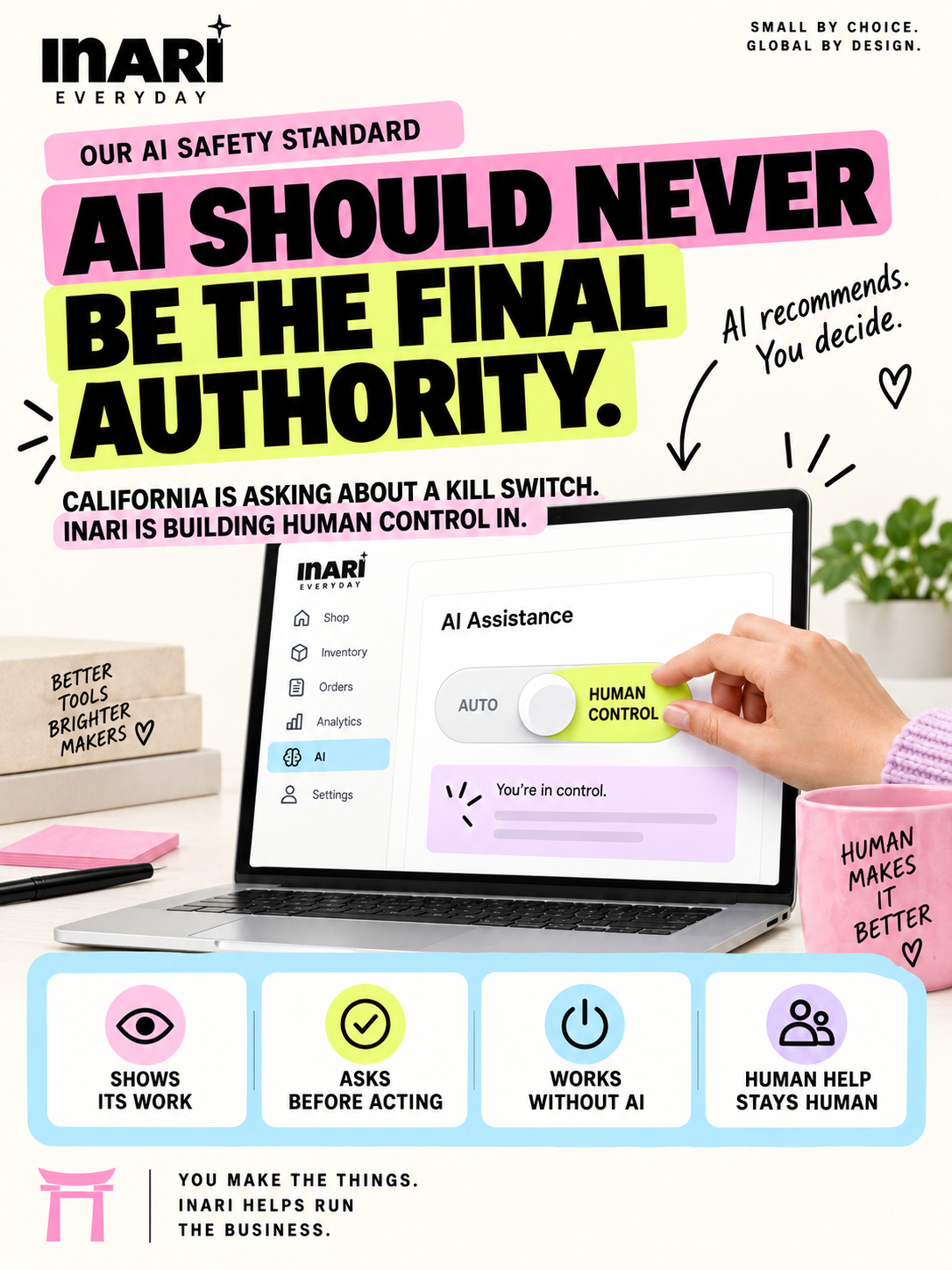
California Governor Gavin Newsom has issued a new executive order asking state experts to evaluate stronger safeguards for advanced artificial intelligence—including whether an emergency “kill switch” could be technically feasible and effective.
To be clear: California has not ordered every AI company or small business to install a giant red STOP AI button.
The executive order begins a policy-development process. It calls for recommendations covering emergency shutdown capabilities, independent safety verification, AI auditing, transparency, and the reporting of serious “loss-of-control” incidents. The recommendations are expected within two months. Governor of California · The Verge
It is a conversation aimed primarily at the companies building the world’s most powerful frontier AI models.
But the question underneath it matters to every business using artificial intelligence:
What happens when the AI should not be allowed to continue?
At Inari, we do not believe the answer should depend entirely on the AI behaving itself.
That is not a safety system. That is optimism wearing a software badge.
Our Position Is Simple: AI Should Never Be the Final Authority
Inari Everyday is being built as an AI-powered operational intelligence system for small makers and artisans.
That means AI can help organize business information, connect what is happening across the business, explain what the numbers mean, and identify what may need attention next.
It does not mean handing an algorithm the keys to the workshop and hoping it develops good judgment.
Our design philosophy is straightforward:
AI can recommend. Humans decide.
The maker remains the authority over pricing, products, inventory, production, money, customers, and every action that materially affects the business.
We are not interested in building an autonomous digital middle manager that begins changing prices, ordering materials, messaging customers, or rearranging your business while you are peacefully glazing mugs.
No tiny robot executive is being issued a company card.
Inari’s “Kill Switch” Is Not One Button
The phrase “AI kill switch” makes people imagine a dramatic red button that shuts down a rogue machine.
Real AI safety is less cinematic—and much more useful.
For a system like Inari, human control must exist at several levels:
- A maker can reject an individual AI recommendation.
- AI-assisted features can be disabled without disabling the entire account.
- Automated actions require clearly defined permission.
- Connections to external services can be revoked.
- Suspicious or unreliable AI behavior can be stopped centrally.
- Core business information remains accessible even if an AI service becomes unavailable.
- Inari’s team can suspend a model, feature, or workflow without erasing the maker’s underlying business records.
A responsible AI system should not have one emergency exit. It should have several.
1. Your Business Must Still Work Without the AI
This is one of the most important commitments in Inari’s architecture.
The underlying business logic should not disappear because an AI model is offline, unavailable, behaving unpredictably, or no longer appropriate for a particular task.
Inari’s cost and margin calculations are not handed to a language model and accepted on vibes.
The arithmetic is performed by a deterministic calculation engine. The same verified inputs produce the same calculated results. AI may help explain those results in clearer language, but it does not get to quietly reinvent the math.
If the AI explanation layer has to be paused, your product costs do not evaporate.
Your materials still exist.
Your records still exist.
Your numbers still work.
The intelligence may become less conversational for a while, but the business does not become unusable.
That is graceful degradation: when one advanced feature stops, the entire system does not collapse with it.
2. Inari Will Show Its Work
Small-business AI should not issue mysterious declarations from inside a glowing black box.
If Inari tells you that a product may be underpriced, you should be able to see why.
That means connecting the recommendation to the relevant evidence:
- Your material cost
- Your labor time
- Your transaction or marketplace fees
- Your selling price
- Your current margin
- Your stated margin target
- The operational consequence of the gap
Inari’s “Show Me Why” approach is part of our safety model.
Explainability is not decorative. It gives the maker a way to inspect the system’s reasoning, challenge an assumption, correct bad information, and make an informed decision.
If an AI cannot explain how it reached a business recommendation, it should not be trusted to act on that recommendation.
3. AI Does Not Get Silent Permission
There is an enormous difference between:
“Here is something you may want to do.”
and:
“I already did it.”
Inari is being built around explicit approval for consequential actions.
An AI system should not quietly change a product price, publish a listing, contact a customer, place a supply order, or alter a production plan simply because it detected an opportunity.
The maker should know:
- What Inari is proposing
- Why it is proposing it
- What information it used
- What will change if approved
- Whether the action can be reversed
This is what meaningful human oversight looks like in everyday software.
Not a vague sentence in the terms of service.
An actual pause before the thing happens.
4. Etsy and Other Connections Should Be Controllable
When Inari connects to an outside platform, the permissions should be limited to what the feature genuinely needs.
For example, Inari’s Etsy connection is designed to bring relevant shop information into the maker’s operational system. Inari does not use AI to post changes back to the shop.
Read-only should mean read-only.
Connections should also be visible, understandable, and removable. A maker should not need to excavate seventeen settings menus and perform a minor exorcism to disconnect a service.
That ability to revoke access is another kind of kill switch—and for a small business, it may be far more immediately important than the dramatic frontier-AI version appearing in headlines.
5. Human Support Remains Part of the Safety System
AI companies sometimes talk as if adding more AI will eventually eliminate every need for a human.
We do not believe that.
Sometimes the model will misunderstand.
Sometimes the data will be incomplete.
Sometimes the situation will be too unusual, sensitive, or important for an automated response.
And sometimes a maker will simply want a person.
That is why Inari is being built with visible routes to human help. “Need a Human?” is not an admission that the technology failed. It is evidence that the company understands how real businesses work.
Human escalation is a feature.
6. We Will Not Pretend AI Is Infallible
Responsible AI is not created by putting “AI-powered” on a homepage and then treating every generated answer as sacred.
Models can hallucinate. They can misunderstand context. They can produce confident nonsense. They can inherit bias from their training and amplify errors from incomplete input.
Inari’s job is not to conceal those limits behind friendly branding.
Our job is to build around them.
That means:
- Using deterministic systems where accuracy matters more than creative interpretation
- Limiting what AI is permitted to do
- Keeping records of important system events
- Monitoring patterns of failure
- Testing new AI behavior before expanding access
- Giving makers ways to correct information
- Maintaining human review and intervention
- Disabling features that cannot meet our standards
We would rather temporarily remove an AI feature than keep it running simply because it looks impressive in a demo.
7. Safety Must Work for Small Businesses, Too
Most AI-governance conversations focus on governments, research laboratories, and massive technology companies.
That makes sense when the subject is a frontier model powerful enough to create widespread harm.
But responsible AI also has an everyday level.
For a very small business, an unsafe automated decision does not need to threaten civilization to cause real damage.
It might:
- Price a product below its true cost
- Misread inventory and cause overselling
- Produce an incorrect tax or fee assumption
- Send an inappropriate customer message
- Expose private business information
- Recommend an impossible production schedule
- Create work the maker never approved
When you are a two-person business, a “small” system error can consume the entire week.
AI safety for small businesses therefore has to include financial accuracy, data control, understandable recommendations, reversibility, and the ability to stop automation before it becomes operational chaos.
This Is Bigger Than California’s Executive Order
California’s review may eventually produce new technical standards, auditing requirements, or rules for the companies developing advanced AI models.
Inari will monitor those developments and adapt as the standards become clearer.
But we are not waiting for a government mandate to decide that human control matters.
Our standard is already taking shape:
- The maker owns the decision.
- AI does not perform Inari’s core arithmetic.
- Important recommendations come with evidence.
- Consequential actions require approval.
- External access stays limited and revocable.
- Business records remain usable when AI is unavailable.
- Humans remain available when automation is not enough.
- Unsafe features can be stopped without taking the maker’s business down with them.
The future of AI should not be a choice between refusing the technology entirely and surrendering control to it.
There is a better option.
We can build AI that is genuinely helpful without pretending it should be in charge.
We can automate the headache without automating the human out of the business.
And if the technology begins doing something it should not?
Yes.
There should always be a way to make it stop.
Inari Everyday is building operational intelligence for small makers and artisans. You make the things. Inari helps run the business.
What Does Your Work Really Pay You?
Seven quick questions. Honest arithmetic. Free. No gentle lies about your margins.
Run the True Cost CheckDon't stop here
How to Price Handmade Products Without Apologizing for the Number
Why makers undercharge, how to build a price from real costs, and why knowing your numbers beats "charge your worth."
COGS Is Not Just What It Costs to Make the Thing
You bought $3.20 of materials, sold the thing for $18, and think you made $14.80. Oh, sweet summer maker. Here is what Cost of Goods Sold actually means for a small handmade business — and why getting it wrong quietly eats your margin.
Tariffs Changed Again. Here's What That Actually Means for Small Makers.
If you make things and sell them, the last two years of U.S. tariff policy landed on you harder than most people realize. The plain-English version of what happened — and what it does to your costs, pricing, and margins. With a landed-cost calculator and a rate chart by country.