Inari vs. Stocksmith vs. Wix Harmony: Which Small-Business Platform Is Right for Makers in 2026?
September 20, 2026 · 22 min read · Gigi
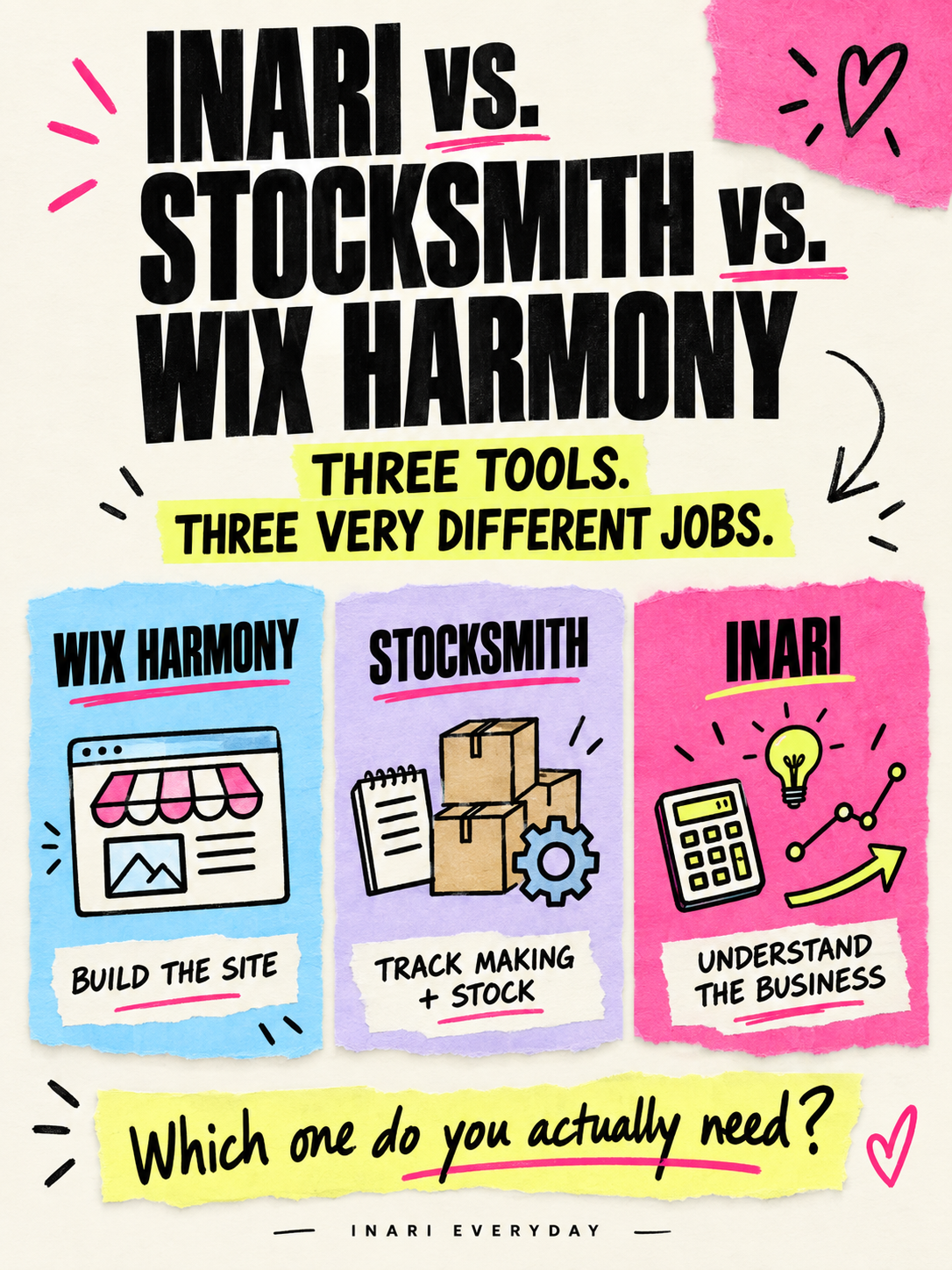
If you run a handmade, creative, or small-batch product business, you may be looking at Inari Everyday, Stocksmith, and Wix Harmony and wondering which platform can actually help you run the business.
The short answer is that these products are not three versions of the same thing.
- Wix Harmony helps you create and operate a website. Its AI agent, Aria, can generate and edit pages, write content, create visual elements, and help configure Wix business features.
- Stocksmith, formerly Craftybase, is inventory, costing, and manufacturing software. It tracks materials, recipes or bills of materials, production, stock, batches, and cost of goods sold.
- Inari Everyday is being built as an AI-powered operational-intelligence system for small makers and artisans. It connects business information, performs reliable cost and margin calculations, explains what those numbers mean, and helps the owner decide what to do next.
That distinction matters. A beautiful online store does not automatically know whether a product is profitable. A detailed inventory system does not necessarily tell an overwhelmed founder which problem deserves attention first. An AI assistant is not automatically operational intelligence simply because it can generate text.
This guide compares Inari, Stocksmith, and Wix Harmony across the questions small product businesses actually have: website creation, e-commerce, costing, inventory, production, AI, setup, decision support, integrations, pricing, and long-term fit.
Disclosure: This article is published by Inari Everyday. We obviously have a point of view. We have also made every effort to describe Stocksmith and Wix Harmony accurately, using their current official product information as of September 2026. Product features and prices can change, so confirm final details directly with each provider.
Inari vs. Stocksmith vs. Wix Harmony at a Glance
| Category | Inari Everyday | Stocksmith, formerly Craftybase | Wix Harmony | |---|---|---|---| | Primary purpose | Operational intelligence for small makers and artisans | Inventory, costing, and manufacturing control | AI-assisted website building and online business infrastructure | | Best suited to | Very small maker businesses that need clarity, guidance, and connected operations | Product businesses that need detailed stock and production records | Businesses that need to build and manage a website or online store | | Core strength | Turns business data into understandable, prioritized action | Tracks materials, production, batches, stock, and COGS in depth | Generates and edits sites using AI plus drag-and-drop controls | | AI role | Interprets, organizes, explains, and guides; deterministic systems handle core math | Not primarily positioned as an AI operations product | Generates site design, content, images, and custom website elements | | Costing | Core capability, including margin, labor, fees, wholesale economics, scenarios, and evidence | Mature cost-per-unit, recipe/BOM, labor, overhead, and automatic cost updates | Store pricing and commerce tools, but not a dedicated maker costing engine | | Inventory | Broader operations roadmap; capabilities vary by released module | Deep, mature inventory and manufacturing tracking | E-commerce product inventory rather than raw-material manufacturing inventory | | Production | Intended to help owners understand and act on operational conditions | Strong batch, lot, BOM, assembly, scheduling, and traceability features | Not a manufacturing execution system | | Website builder | Not its central purpose | No | Yes; this is Harmony's core category | | E-commerce | Optional built-in shop and email capabilities are paid add-ons, not the core product | Connects to external sales channels | Native Wix commerce, checkout, payments, marketing, and related apps by plan | | Decision support | Central product promise | Strong records and reporting; user interprets much of the operational meaning | AI guidance focused primarily on building and improving the site | | Typical buyer question | “What do my numbers mean, and what should I do next?” | “What do I have, what did I make, and what did it cost?” | “How do I build, publish, and improve my website?” |
[[image:/__l5e/assets-v1/ed7cf9e1-d1c8-48df-804e-42e362e8c9dd/inari-stocksmith-wix-three-jobs.png|Wix Harmony creates the site, Stocksmith records inventory and production, and Inari interprets the business.|Three platforms, three different jobs.]]
The Most Important Difference: These Platforms Solve Different Jobs
Search results often place business software in one giant bucket. If a tool uses AI, handles products, or serves small businesses, it gets compared with every other tool that does one of those things.
That creates terrible buying decisions.
A maker does not need “more software.” A maker needs the right system for the right operational job.
Wix Harmony builds the customer-facing business
Wix describes Harmony as a hybrid editor combining natural-language creation with drag-and-drop control. At its center is Aria, an AI agent that can generate pages, sections, text, images, and custom elements. Wix also provides hosting, technical SEO tools, security, and—on suitable plans—commerce, payments, bookings, and other business capabilities.
Harmony therefore works mainly on the customer-facing layer:
- What the website looks like
- What the website says
- How visitors navigate it
- How products are presented
- How customers check out
- How the site performs and gets discovered
That is valuable. It is also different from understanding whether a product's wholesale price covers its labor and fees.
Stocksmith records the physical product operation
Stocksmith describes itself as inventory, costing, and manufacturing software for small-batch product businesses. It tracks raw materials, components, finished goods, recipes or bills of materials, production runs, batches, lots, costs, and sales-channel activity.
Stocksmith therefore works mainly on the manufacturing-control layer:
- What materials are in stock
- What each product uses
- What was manufactured
- What a batch yielded
- What inventory should be deducted
- What the calculated unit cost is
- What can currently be made
- How stock changes as orders arrive
For a growing product company with meaningful production volume, this can be essential infrastructure.
Inari interprets the operating business
Inari is designed around a different problem: many small makers can enter data, but still do not know what the data is telling them.
They can see a margin percentage but not whether it is healthy. They can calculate labor but still underpay themselves. They can record a material-price increase but not understand which product or sales channel now needs attention. They may know the numbers individually while missing the consequence created by those numbers together.
Inari therefore focuses on the operational-intelligence layer:
- What the numbers mean
- What has changed
- What deserves attention first
- Why the system reached that conclusion
- Which input is creating the problem
- What would happen if price, labor, materials, waste, yield, or fees changed
- What the maker can do next
In plain language: Wix Harmony helps build the place where customers buy. Stocksmith helps record the physical process of making and stocking products. Inari helps the owner understand the business and make better operating decisions.
Is Stocksmith the Same as Craftybase?
Yes. Stocksmith is the new name for Craftybase.
The company announced the rebrand in late May 2026, with the name change taking effect on July 1. According to Stocksmith, this was a rebrand—not an acquisition, migration, or product replacement. Existing accounts, data, recipes, manufacturing records, integrations, prices, plans, and logins remained in place. The team also remained the same.
This point is important for anyone searching for:
- Craftybase alternatives
- Craftybase vs. Inari
- Craftybase pricing
- What happened to Craftybase?
- Is Stocksmith replacing Craftybase?
Stocksmith did not replace Craftybase with a new product. Craftybase became Stocksmith. The new brand emphasizes stock, production, costing, and small-batch manufacturing more directly, but the official announcement states that the software itself did not change as part of the rebrand.
That means older Craftybase reviews may still describe parts of the current Stocksmith experience, although buyers should always check the present feature and pricing pages.
Is Wix Harmony an AI Add-On?
Not exactly.
Wix Harmony is better understood as Wix's new AI-focused website editor, released in January 2026, rather than a separate back-office AI add-on that sits beside any business system.
Aria is the AI agent built into the Harmony experience. It can help users:
- Generate a website from a description
- Create pages and sections
- Write or revise website copy
- Generate images
- Change layouts, colors, and styling
- Add commerce and other Wix functionality
- Create editable custom elements
- Improve structure, settings, accessibility, SEO, and conversions
Wix also warns that Aria may produce unexpected or inaccurate results and tells users to review its work before finalizing a site. That is a sensible reminder—and an important clue about Harmony's role. Aria is a creation and website-management assistant, not a dedicated system of record for manufacturing economics.
Calling Harmony an “AI add-on” undersells it as a website-building environment while simultaneously overstating it as a general business-operations brain.
[[image:/__l5e/assets-v1/cf56f0da-a932-4a2a-b5d2-dd93ba38226e/inari-stocksmith-wix-simple.png|The simplest comparison of Wix Harmony, Stocksmith and Inari Everyday.|The simplest comparison: build, track, or understand.]]
Costing and Profitability: Inari vs. Stocksmith vs. Wix Harmony
For a maker business, “What does this product cost?” is not a simple question.
The honest unit cost may include:
- Raw materials
- Components and packaging
- Material waste
- Labor time and labor rate
- Batch yield
- Overhead allocation
- Payment-processing fees
- Marketplace fees
- Channel-specific selling costs
- Discounts or promotions
- Wholesale pricing requirements
Stocksmith's approach to product costing
Stocksmith has mature product-costing capabilities tied closely to inventory and production. Its official product pages describe multi-level bills of materials, sub-assemblies, batch sizing, yields, labor, overhead, and automatic cost rollups when material prices change.
This is especially useful when accurate cost depends on a structured production record. If a serum uses a reusable base mixture, or a gift set contains several assembled products, multi-level BOMs can model those relationships. When manufacturing is recorded, Stocksmith can deduct the relevant materials and add finished units to stock.
Stocksmith is the strongest of these three choices when the primary requirement is mature, detailed manufacturing costing connected to physical inventory movements.
Inari's approach to product costing
Inari COST begins with accurate calculation but does not stop at producing a number.
Its cost engine is designed to calculate materials, labor, fees, profit, margin, break-even conditions, channel economics, and hourly return. The important architectural distinction is that core arithmetic is deterministic: the same verified inputs produce the same calculated outputs. The language model does not improvise the math.
AI is used to make the result easier to understand—not to secretly recalculate it.
Inari then adds layers that a basic calculator or recordkeeping system often lacks:
- INARI SAYS: prioritized, plain-language observations about what needs attention
- Show Me Why: the input, calculated value, target, and consequence behind an insight
- What If scenarios: non-destructive modeling of changes to price, labor minutes, materials, waste, fees, or batch yield
- Minimum wholesale price guidance: helps a maker identify a viable floor rather than guessing at a multiplier
- Channel economics: shows how fees and selling conditions affect profitability in different places
- Business memory: reusable materials, suppliers, components, products, and owner defaults stay connected instead of being re-entered for every calculation
The difference is emphasis. Stocksmith is deeply interested in maintaining an accurate production and inventory system. Inari is deeply interested in helping the maker understand the operational consequence and choose an action.
Wix Harmony's approach to costing
Wix commerce can support product prices, orders, payments, discounts, tax features, and store inventory. Harmony can help build and configure those customer-facing systems.
However, Wix Harmony is not positioned as specialized costing or manufacturing software for handmade and small-batch businesses. It does not become a raw-material costing engine simply because a product has a price field in an online store.
If you need to know whether your handmade candle, ceramic mug, art print, soap batch, sewn product, or gift set is truly profitable after labor, waste, packaging, and channel fees, you will generally need a specialized operational or costing system alongside the website.
Inventory and Manufacturing: Where Stocksmith Is Strongest
Stocksmith has the clearest advantage in mature inventory and production management.
Its published capabilities include:
- Raw-material, component, and finished-goods inventory
- Recipes and bills of materials
- Multi-level BOMs on higher plans
- Production assemblies
- Batch and lot tracking
- Material deductions when products are manufactured
- Production history
- Low-stock monitoring
- Purchase history
- Production scheduling on qualifying plans
- Traceability and compliance reporting
- Sales-channel integrations
- Automatic stock synchronization on qualifying plans
This is not a side feature. It is the center of the product.
If your biggest operational pain is inaccurate stock, complex bills of materials, lot traceability, purchase histories, or coordinating production across a team, Stocksmith deserves serious consideration.
Inari's broader product vision includes connected materials, inventory, orders, making, and money views, but buyers should judge released capabilities rather than treating a roadmap as though it were already shipping. Inari's current differentiation is not “we have every mature MRP feature Stocksmith has.” The differentiation is that it is being designed around lower-friction setup, connected business memory, prioritized insight, scenario planning, and guidance for a very small owner-operated business.
Wix can manage e-commerce stock at the finished-product level, but it is not designed to replace manufacturing inventory software. Selling five candles through a Wix store can reduce the online quantity of those candles. That is not the same as calculating how much wax, fragrance, wick, dye, jar stock, labels, and packaging remain after a batch.
AI: Three Very Different Meanings
“AI-powered” has become so broad that it is nearly useless without a second question: What is the AI actually allowed to do?
AI in Wix Harmony: create and modify the website
Harmony's Aria understands site context and can generate or change website elements through natural language. This can dramatically reduce the effort involved in turning an idea into a live site.
Its AI is strongest when the task sounds like:
- “Build a homepage for my ceramics business.”
- “Change this section to match my brand colors.”
- “Write product-category copy in a warmer tone.”
- “Add a product carousel.”
- “Help improve this page for search.”
- “Create a sales banner.”
That is website intelligence.
AI in Inari: interpret the operating business
Inari's AI is intended to work with structured business memory and deterministic calculations. The system can help collect information, explain results, surface patterns, and translate operational evidence into understandable guidance.
Its AI is strongest when the task sounds like:
- “Why is this product's margin lower than my target?”
- “Which input is hurting my wholesale economics?”
- “What happens if material costs rise 12%?”
- “How much would I need to raise the price if I paid myself properly?”
- “What should I address first?”
- “Show me the evidence behind that recommendation.”
That is operational intelligence.
Inari's design rule is that AI does not become the final authority. It can recommend; the maker decides. Consequential actions should require permission, external connections should be limited and revocable, and the core records and calculations should remain useful if the AI explanation layer is unavailable.
AI in Stocksmith: not the core buying reason
Stocksmith's current public positioning centers on accurate inventory, manufacturing, costing, and connected sales channels—not on being an AI agent or conversational operating partner.
That is not automatically a weakness. Many businesses need reliable systems of record more than they need a chatbot. A mature database of materials, production runs, lots, purchases, and stock movements can be more valuable than an AI layer that sounds impressive but cannot be trusted.
The useful comparison is therefore not “Which product says AI most often?” It is “Which kind of intelligence does the business need?”
Setup and Learning Curve
Every business system demands something from the user. The question is whether the value returned justifies the setup burden.
Stocksmith setup
A detailed inventory and manufacturing system needs detailed operational data. Users may need to establish materials, units, suppliers, recipes, products, opening stock, production processes, sales channels, and historical assumptions.
Stocksmith says setup takes hours rather than weeks, but the exact workload depends on catalog size and production complexity. The more precise the inventory system, the more important consistent inputs and workflows become.
That tradeoff can be worth it for businesses whose stock and production complexity have outgrown lighter tools.
Wix Harmony setup
Harmony aims to reduce website setup by letting users describe what they want. A user can begin with AI, a template, or a blank canvas, then refine the result visually.
This can make site creation faster, but the business owner still needs to make decisions about brand, products, pricing, policies, payments, fulfillment, navigation, and content. AI can generate a page; it cannot decide what your business should promise customers unless you supply the truth.
Inari setup
Inari is being designed to reduce the traditional blank-form problem. Its Quickstart flow allows a maker to describe a product naturally, uses AI to extract possible details, presents them for review, identifies only what is missing, normalizes units, and writes confirmed information into the underlying structured system.
This is a crucial distinction: conversational setup should not mean unverified data silently entering the business record. The maker sees and corrects the extracted information before it becomes real.
The goal is high-touch onboarding without requiring the founder to schedule a five-person implementation team she does not have.
Explainability and Trust
Small businesses cannot afford confident nonsense.
An incorrect recommendation does not have to cause a global crisis to do real damage. It can price a product below cost, create an impossible production plan, cause overselling, or consume an entire week of a two-person company's time.
Inari's “Show Me Why” layer is meant to expose the evidence behind an operational conclusion:
1. The input used 2. The calculated value 3. The maker's target or relevant threshold 4. The practical consequence
For example, Inari should not merely declare, “Your wholesale price is too low.” It should show the labor, materials, fees, current margin, target margin, and resulting gap.
Stocksmith's strength is auditable operational data: materials, purchase history, BOM structure, production records, batches, and inventory movements. Its explainability is largely rooted in records and reports.
Wix Harmony gives users direct visual control over AI-generated website work and specifically advises them to review Aria's output. For site creation, being able to inspect and edit the generated result is essential. But this is different from exposing the financial evidence behind a profitability recommendation.
E-Commerce, Checkout, and Selling Online
If the main goal is to launch an online store, Wix Harmony is the most direct choice of the three.
Wix can provide the public website, product pages, checkout, payments, hosting, security, marketing functions, customer-facing design, and additional business apps. Harmony makes that environment easier to create through prompts and manual editing.
Stocksmith is not a storefront builder. It connects operational records with selling channels such as Shopify, Etsy, WooCommerce, Faire, and Amazon, depending on the integration and plan. Its job is to help the back office respond when products are made or sold.
Inari's core purpose is also not to become a generic website builder. A built-in shop and email system are available as optional paid capabilities for makers who want a more connected customer-facing experience. But the shop is intended to plug into the AI operations backend—not replace the operational backend with a pretty storefront.
This produces three distinct models:
- Wix Harmony: website first, with business and commerce capabilities wired in
- Stocksmith: inventory and manufacturing first, connected to external stores
- Inari: operational intelligence first, with optional selling tools connected to the same business memory
Integrations and Data Flow
Integrations matter because no small-business owner wants to type the same order into five systems.
Stocksmith has the most established sales-channel synchronization story in this comparison. Its current site describes connected order and stock workflows, with plan differences around import frequency, automatic stock sync, Amazon, and QuickBooks inventory capabilities.
Wix's advantage is native ecosystem breadth. The website, checkout, customer accounts, marketing, bookings, analytics, and additional apps can live within the Wix platform. Harmony can help add and configure site functionality.
Inari's approach is intentionally conservative about external authority. Its announced Etsy connection is designed to bring shop data into Inari—including orders and relevant listing information—while remaining read-only. Inari's AI does not post changes back to the shop.
That constraint is part of the product philosophy: bringing information into an intelligence system does not automatically give the intelligence system permission to alter the source.
Pricing Comparison in 2026
Pricing should be compared carefully because the products include different things.
Stocksmith pricing
As of September 2026, Stocksmith's public pricing page lists:
- Indie: $83 per month on annual billing or $99 month-to-month
- Business: $166 per month on annual billing or $199 month-to-month
- Growth: $291 per month on annual billing or $349 month-to-month
Stocksmith's help center also references a lower Studio plan, but it is not shown on the main public pricing page at the time of writing. Confirm availability directly before comparing totals. Stocksmith offers a 14-day free trial. Higher tiers add capacity and capabilities such as more frequent imports, automatic stock sync, production scheduling, Amazon integration, two-factor authentication, QuickBooks inventory sync, and priority support.
Wix pricing
Wix's current public plans page lists these annual-billing headline prices:
- Light: $17 per month
- Core: $29 per month
- Business: $39 per month
- Business Elite: $159 per month
Wix also offers a free website plan with limitations. Businesses that need payments and e-commerce should evaluate Core or above, while requirements for advanced commerce, automation, analytics, storage, and collaboration may push the business to a higher tier. Pricing, taxes, regional differences, payment-processing fees, third-party apps, email services, and other add-ons can affect the actual total.
Harmony's AI tools are presented as part of the Wix creation experience rather than a separate operations-software subscription.
Inari pricing
Inari Everyday is currently offered at $77 per month for the core operations system. Inari Shop is a separate optional add-on at $53 per month; it is not required to use Product Costs, Materials, Orders, Money, planning, or the rest of the core system. Confirm current terms on the Inari start page before buying.
More importantly, the cheapest subscription is not always the lowest-cost system. Buyers should include:
- Setup time
- Data-entry time
- Required add-ons
- Payment-processing fees
- Integrations
- Training
- The cost of errors
- The value of decisions the system helps—or fails—to make
[[image:/__l5e/assets-v1/303439b6-a14a-4a68-b471-d3bacd98ba0a/inari-stocksmith-wix-choice.png|Decision guide for choosing Wix Harmony, Stocksmith or Inari based on a maker business’s biggest problem.|Start with the problem, not the logo.]]
Which Platform Is Best for a Handmade Business?
There is no universal winner. There is a correct match for the problem.
Choose Wix Harmony if your main problem is building a website
Wix Harmony is likely the strongest fit if:
- You need a website or online store
- You want AI to generate and revise pages
- You want drag-and-drop control after AI generation
- You need hosting, security, checkout, payments, or bookings
- You want marketing and website tools within one large ecosystem
- Your inventory needs are primarily finished-product e-commerce inventory
Harmony can help you open and improve the digital front door. It is not a substitute for detailed maker costing or manufacturing control.
Choose Stocksmith if your main problem is inventory and production
Stocksmith is likely the strongest fit if:
- You have meaningful raw-material and component inventory
- You manufacture in batches
- You need BOMs, sub-assemblies, lots, or traceability
- You need stock to change as products are made and sold
- You manage a production team or growing order volume
- You want a mature product with a long operating history
- You need detailed manufacturing records more than conversational guidance
Stocksmith is a serious system for keeping product operations accurate. That power may be more system than a tiny beginner needs, but it can be exactly what a growing manufacturer requires.
Choose Inari if your main problem is knowing what to do
Inari is being built for the maker who says:
- “I have numbers, but I do not know what they mean.”
- “I do not know whether my price is actually safe.”
- “I cannot afford an operations team.”
- “I need the software to explain the consequence, not just store the data.”
- “I want to test a change before making it real.”
- “I need help finding the problem without digging through twelve reports.”
- “I want AI involved, but I do not want it inventing the math or silently changing my business.”
Inari is intended for very small makers and artisans who need operational leverage without pretending they have the staff, time, or tolerance for an enterprise implementation.
Can You Use More Than One?
Yes—and for some businesses, that is the most sensible answer.
A maker could use:
- Wix Harmony for the website, store, and customer experience
- Stocksmith for detailed inventory, manufacturing, traceability, and production records
- Inari for operational interpretation, scenario planning, prioritized guidance, and connected decision support
Whether that combination is worth the expense depends on business size and data flow. Three overlapping systems can create duplicate work if integrations are weak. But three tools with clearly separated roles can also be more effective than forcing one platform to do jobs it was not designed to do.
The correct stack is not the one with the most logos. It is the one in which each system has a clear responsibility and the owner understands where the authoritative data lives.
The Bottom Line
Inari, Stocksmith, and Wix Harmony should not be judged as interchangeable competitors.
Wix Harmony is a website-building platform with an AI agent. It helps turn ideas into functioning, editable websites and connects those sites to Wix's commerce and business infrastructure.
Stocksmith is mature inventory and manufacturing software. It tracks the physical truth of a product business: materials, recipes, production, batches, stock, costs, and sales-channel movement.
Inari is an operational-intelligence platform for small makers and artisans. It is being built to connect business memory with reliable calculations, explain what those calculations mean, surface what needs attention, and help the maker act without surrendering control to AI.
The simplest comparison is this:
- Wix Harmony helps you build where the business sells.
- Stocksmith helps you record what the business makes and stocks.
- Inari helps you understand how the business is actually doing—and what to do next.
For many small makers, the real enemy is not a lack of data. It is having data everywhere and useful answers nowhere.
That is the gap Inari is built to close. If pricing is the pain point, start with the free True Cost Check. For the control philosophy behind the system, read how Inari keeps makers in control of AI.
You make the things. Inari helps run the business.
Frequently Asked Questions
Is Stocksmith the same as Craftybase?
Yes. Craftybase was rebranded as Stocksmith in 2026. According to the company, the account data, product functionality, integrations, pricing, ownership, and team remained the same during the rebrand.
Is Inari a Craftybase or Stocksmith alternative?
Inari may be an alternative for makers whose main need is costing, margin clarity, scenario planning, and guided operational decisions. It is not currently a one-for-one replacement for every mature Stocksmith manufacturing feature, especially advanced inventory, production scheduling, lot tracking, traceability, and multi-level BOM workflows.
Is Wix Harmony inventory-management software?
Wix supports product inventory for online stores, but Harmony is fundamentally an AI-assisted website editor. It is not specialized raw-material, BOM, batch, or manufacturing-inventory software in the way Stocksmith is.
Can Wix Harmony calculate the true cost of handmade products?
Wix can store selling prices and support commerce, but Harmony is not positioned as a dedicated true-cost engine for materials, labor, waste, batch yield, marketplace fees, and channel-specific margin analysis. Makers with those needs should use specialized costing or operations software.
Does Stocksmith use AI?
Stocksmith's current public positioning emphasizes inventory, manufacturing, costing, reporting, and integrations rather than an AI operating agent. Its principal value is structured operational control and accurate records.
How is Inari's AI different from Wix Aria?
Wix Aria is designed to build and improve websites. Inari's AI is designed to interpret small-business operational data, explain calculated results, help collect structured information, and guide decisions. Inari's core arithmetic is performed by deterministic software rather than delegated to the language model.
Which is better for Etsy sellers?
It depends on the Etsy seller's problem. Wix Harmony is useful if the seller wants to build a separate website. Stocksmith is useful if the seller needs detailed inventory and manufacturing tracking. Inari is useful if the seller needs to understand product economics, fees, margins, and operational priorities. Inari's announced Etsy integration is read-only, while Stocksmith offers established sales-channel integration workflows.
Which is best for a one-person handmade business?
A solo maker who primarily needs a website may prefer Wix Harmony. A maker with complex production and inventory may prefer Stocksmith. A maker who needs low-friction costing, plain-language insight, and help deciding what to fix next may find Inari the better fit.
Which is best for a growing small-batch manufacturer?
Stocksmith is currently the most mature choice of these three for detailed production, inventory, BOMs, traceability, and manufacturing workflows. Inari may complement that operational record with interpretation and guidance as its integrations and modules expand.
Can Inari replace my website?
Inari's core product is not a general-purpose website builder. Optional shop and email capabilities are planned, but businesses that want broad website design freedom and a mature web ecosystem should compare dedicated platforms such as Wix.
Can these platforms work together?
Potentially. Wix can serve the customer-facing website, Stocksmith can manage manufacturing records, and Inari can provide operational interpretation. The practical value depends on integrations, data ownership, subscription cost, and how much duplicate entry the workflow requires.
Sources and Product Information
What Does Your Work Really Pay You?
Seven quick questions. Honest arithmetic. Free. No gentle lies about your margins.
Run the True Cost CheckDon't stop here
AI Did Not Steal Five Jobs From My Small Business. Those Jobs Never Existed.
Does AI replace small-business jobs? For many tiny companies, the departments never existed. AI can create capacity where there was none.
California Is Exploring an AI “Kill Switch.” Here’s How Inari Is Building for Human Control Now.
California is exploring an AI kill switch. Here is how Inari builds human control, explainability, approval, and graceful degradation into AI for small business.
How to Price Handmade Products Without Apologizing for the Number
Why makers undercharge, how to build a price from real costs, and why knowing your numbers beats "charge your worth."