How to Price Handmade Products Without Apologizing for the Number
September 16, 2026 · 9 min read · Gigi
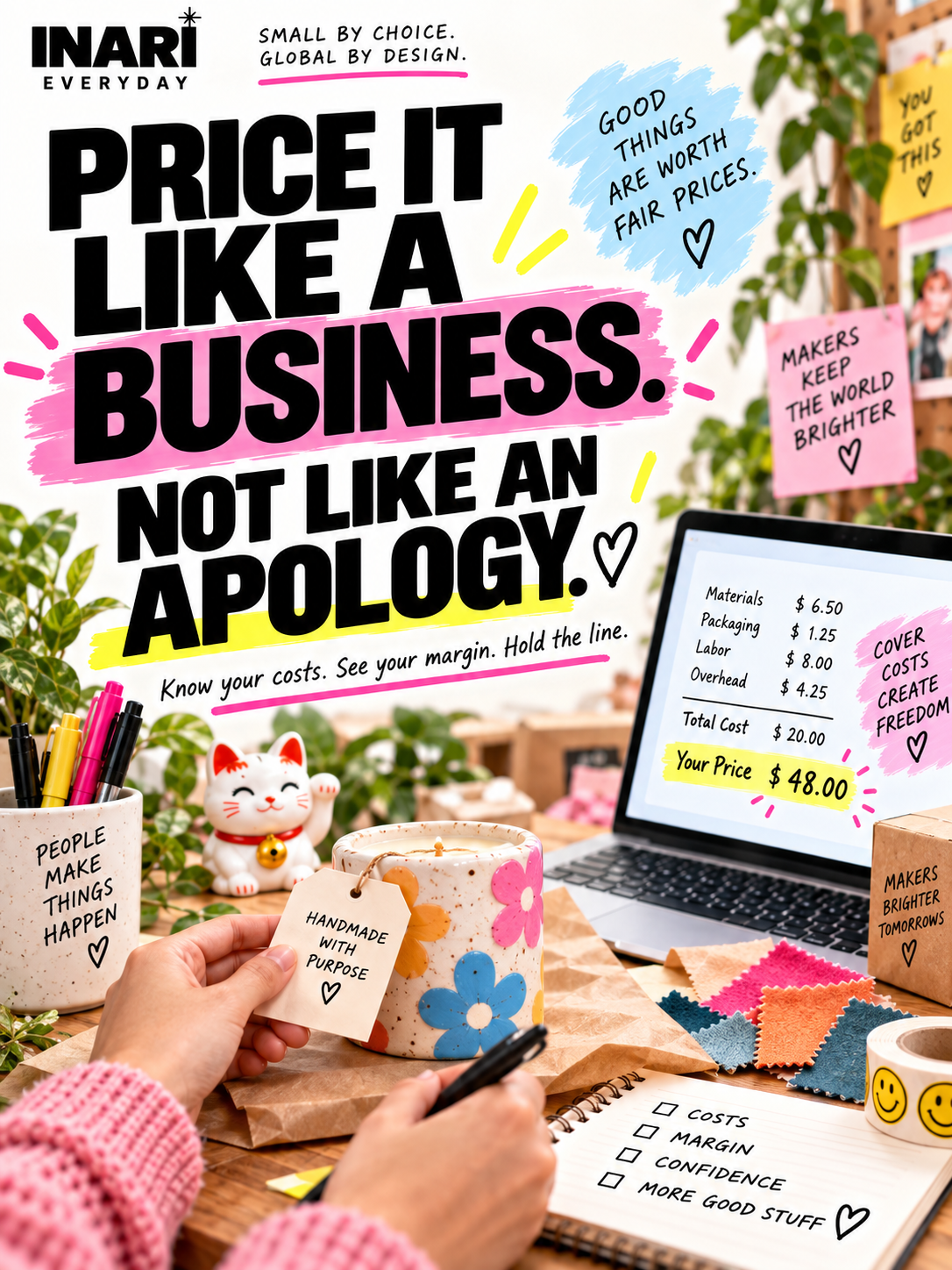
"Charge your worth."
Cute advice. Now tell me what that means for a product that takes 47 minutes to make, uses six materials, has unpredictable waste, and sells through a platform that takes fees.
That's where the motivational poster usually abandons you.
For small makers and artisans, pricing is rarely just a math problem. It's a math problem wearing an anxiety costume. You're trying to account for materials, labor, packaging, fees, and profit while a tiny voice in your head says, But what if nobody buys it?
So you round down. You leave out your time. You tell yourself you'll raise prices once you're "more established."
Meanwhile, your business is busy proving that you can work incredibly hard for surprisingly little money.
Let's fix the numbers and talk about why it's so difficult to stand behind them.
Why handmade pricing feels so personal
When you make something with your hands, it can feel as though the customer is judging you, not just the product. A shopper hesitating at the price can sound, in your head, like a verdict on your talent.
It isn't.
Customers make buying decisions for all kinds of reasons: budget, timing, taste, priorities, or whether they needed that particular item today. "Not for me at this price" does not mean "your work has no value."
But when those two thoughts get tangled together, undercharging can start to feel like protection. A lower price seems less likely to invite criticism or rejection.
There's another trap: comparison. You see a similar item listed for less and assume you need to match it. You don't know that seller's material costs, production time, overhead, margins, or financial goals. You may not even know whether their price is working for them.
A competitor's price is market information. It is not your cost structure.
"I like making it" is not a labor discount
You can love your craft and still pay yourself for your time. Those ideas are not in conflict.
Your labor includes more than the visible minutes spent making the item. There may be setup, finishing, quality checks, cleanup, and packing. Then there's the work around the product: ordering supplies, answering questions, photographing listings, and running the business.
Not every minute belongs in the unit labor cost; some belongs in overhead. But all of it has to be supported by the business somehow.
If your pricing only covers supplies and the time you remember to count, you're not proving that your products are affordable. You may be quietly subsidizing every sale with unpaid work.
And no, being delighted by what you make does not mean your labor becomes free.
How to calculate a handmade product price
A useful starting point is to build the price from its actual components:
Materials + production labor + packaging + allocated overhead + selling costs + profit target
Depending on your business, selling costs might include marketplace fees, payment processing, promotions, or the shipping expense you choose to absorb. Waste and failed batches may also need to be reflected in your costs.
The precise calculation varies by product and sales channel. The point is to stop asking, "What price feels safe?" before you've asked, "What does this sale need to cover?"
For example, imagine you sell a handmade item for $30. If materials, labor, packaging, and allocated overhead total $22, you have $8 left before relevant selling fees and other expenses. That $8 is not automatically profit.
This is why a product can sell well and still leave you wondering where the money went.
For a handmade pricing strategy that can last, look beyond the individual sale. Can this price support replacement supplies, your time, slower months, mistakes, and the next stage of your business? What happens to the numbers if you offer a discount or sell wholesale?
Those questions are not pessimistic. They are how you give your creativity a business it can live inside.
Why knowing your numbers changes your confidence
Pricing confidence is often presented as a personality trait: become bolder, speak more firmly, stop caring what people think.
That may help at a market table. It does not tell you whether $42 is a sustainable price.
A more useful kind of confidence comes from being able to explain the decision to yourself. When you know your costs, margin, and minimum viable price, you're no longer defending a number you pulled out of the air. You have a reason.
This connects to a broader idea in psychology called self-efficacy: confidence in your ability to handle a particular task. It is not simply positive thinking. Experience, feedback, and evidence can help build it. The American Psychological Association explains the concept here.
In pricing, that means confidence can grow through a repeatable process:
- Calculate what the product actually costs.
- See what remains at different prices.
- Test a price with real customers.
- Review the result.
- Adjust with evidence, not panic.
That is a very different feeling from whispering "I'm worth it" while secretly hoping nobody asks you to show your math.
A customer saying "that's expensive" is not a pricing formula
Sometimes a price objection reveals a genuine problem. Perhaps the product's value is unclear. Perhaps you're reaching the wrong audience. Perhaps your costs are too high for that particular product to work at a competitive price.
Sometimes the customer simply cannot or does not want to buy it.
You need enough information to tell those situations apart. Dropping your price every time someone hesitates is not a strategy; it's letting the most recent comment run your business.
Instead, ask better questions. Are people viewing the product but not buying? Do customers understand the materials, function, and care that make it different? Does the price leave room for your business to operate? Could a different design, batch size, or sales channel improve the economics?
You can be open to feedback without letting every stranger with a raised eyebrow become your CFO.
Where Inari comes in
Inari Everyday helps small makers and artisans get out of the pricing fog.
Inari COST keeps your materials and product components organized, builds the cost of a product from your inputs, and shows what a proposed price means for your retail or wholesale economics. You can explore what-if changes—like a higher material cost, different labor time, or a new selling price—without overwriting the product you're already working with.
And when Inari flags something, Show Me Why helps you see the inputs and calculation behind the insight. The math comes from the cost engine; AI helps explain what the result means in plain language. It doesn't get to invent a more encouraging margin because we're all having a difficult Tuesday.
Inari cannot decide what your craft is worth to the world. That belongs to you and the market you're building. What it can do is show you what your business needs from a price, where the pressure points are, and what changes when you adjust it.
That's more than a number on a screen. It's something solid to stand on.
You do not have to apologize for a sustainable price
A good price is not necessarily the highest number you can persuade someone to pay. And charging more will not rescue a product whose costs or demand do not work.
A good price is a deliberate one: informed by your costs, your customers, your sales channel, and the business you want to keep running.
You're allowed to test it. You're allowed to revise it. You're allowed to discover that one product needs a redesign, a different audience, or a firm goodbye.
What you do not have to do is price from fear and call the resulting exhaustion "being passionate."
Make the thing. Know the numbers. Hold the line when the numbers support it—and change course when they don't.
You make the things. Inari helps run the business.
What Does Your Work Really Pay You?
Seven quick questions. Honest arithmetic. Free. No gentle lies about your margins.
Run the True Cost CheckDon't stop here
COGS Is Not Just What It Costs to Make the Thing
You bought $3.20 of materials, sold the thing for $18, and think you made $14.80. Oh, sweet summer maker. Here is what Cost of Goods Sold actually means for a small handmade business — and why getting it wrong quietly eats your margin.
Tariffs Changed Again. Here's What That Actually Means for Small Makers.
If you make things and sell them, the last two years of U.S. tariff policy landed on you harder than most people realize. The plain-English version of what happened — and what it does to your costs, pricing, and margins. With a landed-cost calculator and a rate chart by country.