COGS Is Not Just What It Costs to Make the Thing
September 6, 2026 · 18 min read · Gigi
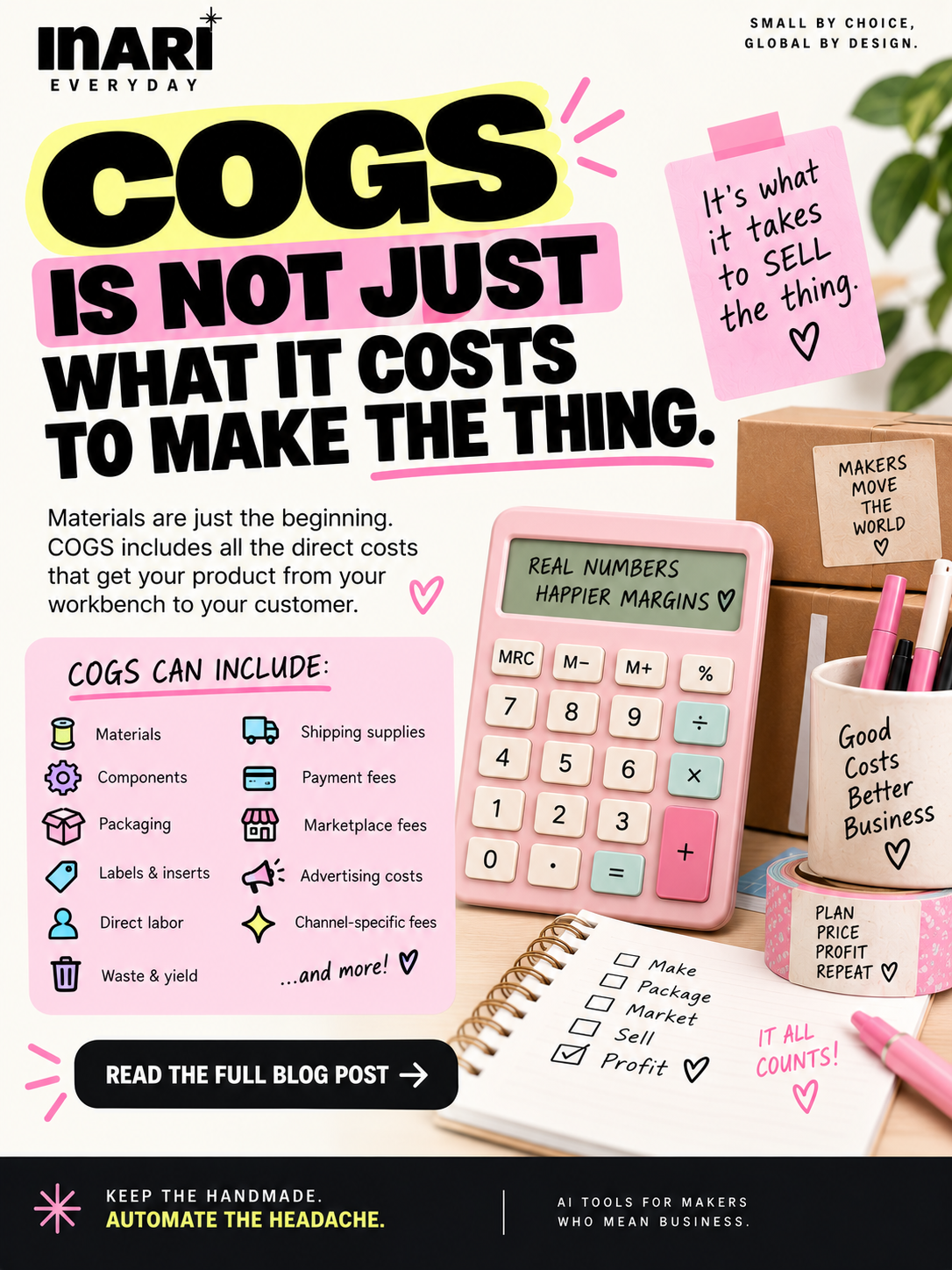
The number small makers keep undercounting — and why it matters more than you think.
You bought $3.20 worth of materials.
You made the thing.
You sold the thing for $18.
So you made $14.80, right?
Oh, sweet summer maker.
No.
Somewhere between “I made this for $3.20” and “someone bought it for $18,” an entire parade of tiny expenses marched through your business wearing fake mustaches and hoping you wouldn't notice them.
Packaging.
Labels.
Components.
Finishing materials.
Merchant fees.
Marketplace fees.
And depending on how your business accounts for costs, potentially direct production labor and other costs directly tied to getting that specific product sold.
Individually, many of these numbers look harmless.
Twenty-seven cents here.
Forty-two cents there.
A dollar somewhere else.
But put them together across 50, 500, or 5,000 orders?
That is your margin.
And if you're running a small handmade or small-batch business, understanding your Cost of Goods Sold — COGS — is one of the most important things you can do for your business.
Not because accounting is exciting.
It isn't.
We're not going to pretend.
But because you cannot confidently price, discount, wholesale, advertise, or grow a product when you don't actually know what that product costs you to sell.
So let's fix that.
First: What Does COGS Actually Mean?
COGS stands for Cost of Goods Sold.
In accounting terms, COGS generally refers to the direct costs attributable to the goods your business actually sold during a given period.
That distinction matters.
COGS isn't simply:
What did the materials cost me?
And it isn't literally every expense involved in running your business, either.
A better question is:
What direct product costs did my business incur for the goods I actually sold?
For a maker, that can include considerably more than the obvious raw material sitting in the finished product.
Let's say you make candles.
You might immediately think:
- Wax
- Fragrance
- Wick
- Vessel
Great.
Those are obvious product costs.
But what about the wick sticker?
The warning label?
The product label?
The lid?
The box specifically used for that candle?
The protective insert?
Those tiny costs count, too.
Your product didn't teleport naked from your workbench into your customer's hands.
Making the product and having a sellable product are not always the same thing.
And that distinction is where a lot of tiny businesses accidentally lie to themselves about their margins.
COGS ≠ Materials
This is probably the biggest mistake I see small makers make.
They calculate the raw materials.
Then stop.
Let's imagine you're making a handmade product that sells for $24.00.
Your materials look like this:
- Main material — $2.10
- Hardware — $0.65
- Decorative component — $0.40
- Finish — $0.20
- Materials: $3.35
You look at that and think:
“Excellent. It costs me $3.35 to make, and I sell it for $24.”
That sounds delightful.
Except we aren't finished.
Maybe the finished product also requires:
- Product label — $0.18
- Backing card — $0.24
- Protective sleeve — $0.11
- Branded sticker — $0.08
- Product box — $0.55
- Packaging insert — $0.14
- Additional costs: $1.30
Now we're at $4.65.
And depending on your accounting method and sales channel, there may be other costs you need to track separately when calculating the economics of that sale.
That's why I don't want makers thinking:
Material cost = what this product costs my business.
Those are two very different questions.
But There's an Important Accounting Distinction Here
This is where we're going to be responsible adults for approximately 45 seconds.
Not every cost involved in selling something is technically COGS for accounting or tax purposes.
For example, businesses may track things such as:
- Payment-processing fees
- Marketplace commissions
- Advertising
- Website subscriptions
- General office supplies
- Rent
- Software
- General shipping expenses
separately from COGS.
Your accounting treatment can also vary based on the type of business, inventory method, jurisdiction, and how particular expenses are incurred.
So when I say you need to know what it costs to sell the thing, I'm talking about something slightly broader than simply finding the COGS line on your tax return.
As an owner, you need two useful views of your numbers:
1. Accounting COGS
The direct costs attributable to the products you sold.
2. Your true per-sale economics
What happens financially when one of those products actually leaves your shelf and becomes an order.
Those numbers can overlap heavily.
But they aren't necessarily identical.
And you should know both.
Your accountant needs accurate books.
You need to know whether selling another one of these things actually makes you money.
What Usually Goes Into COGS for a Maker?
There isn't one universal COGS formula that fits every handmade business.
A ceramicist has different costs from a sticker shop.
A soap maker has different costs from someone running twelve 3D printers.
But direct product costs commonly include categories like these.
Raw Materials
This is the obvious one.
Wood. Clay. Wax. Resin. Fabric. Paper. Ink. Vinyl. Yarn. Beads. Metal. Leather. Fragrance oils.
Whatever physically becomes part of your product.
But don't estimate.
If you buy 100 feet of material for $40 and each product uses 2.5 feet, calculate the actual unit cost.
Because:
“Eh, probably about fifty cents” is not an accounting system.
Components Count Too
Small components are incredibly easy to ignore.
Clasps. Magnets. Screws. Jump rings. Wicks. Fasteners. Elastic. Adhesive. Backing boards. Protective films. Replacement blades consumed in production.
Even if something costs nine cents per unit, it is still nine cents.
Sell 10,000 units?
Congratulations.
Your irrelevant nine-cent component just became $900.
Tiny numbers become extremely non-tiny when you multiply them.
Packaging Can Be Part of the Product Cost
This is another place makers tend to undercount.
There is a difference between general shipping expense and packaging that is directly associated with a particular product or unit.
Think:
- Retail box
- Product sleeve
- Backing card
- Hang tag
- Bottle
- Jar
- Lid
- Product-specific insert
- Protective packaging necessary for the product
- Product label
If you cannot sell that item in its finished form without that packaging, you should at minimum know exactly what that packaging costs you per unit.
Whether a particular packaging expense is classified as COGS in your books is something to confirm with your accountant.
But operationally?
Know the number.
Labels Are Not Free Because You Printed Them Yourself
This one is sneaky.
You bought a label printer six months ago.
Now you print labels.
So the labels feel free.
They are not.
You're consuming:
- Label stock
- Ink or toner, depending on your setup
- Printer consumables
- Specialty papers
- Laminate
- Adhesive sheets
The machine itself is generally treated differently from the consumable material it uses.
But those consumables?
They have a cost.
And if every product uses them, that cost belongs somewhere in your product economics.
Then We Need to Talk About Labor
Oh, yes.
Your time.
The thing small business owners apparently decided has a market value of approximately zero dollars.
If you spend 35 minutes making something, that time has economic value.
If an employee spends 35 minutes making it, you obviously have a labor cost.
When you spend 35 minutes making it, somehow the maker brain goes:
“Well, I was already here.”
No.
Absolutely not.
Your time did not become free because you're emotionally attached to the company.
For accounting purposes, how owner labor is treated depends heavily on your business structure and tax/accounting situation. Don't randomly shove an imaginary hourly wage into tax COGS because a blog told you to.
But for pricing and profitability decisions, you should absolutely understand the labor required to produce your products.
If Product A generates $12 of contribution before considering your time but requires 90 minutes of hands-on work, while Product B generates $9 and requires seven minutes?
Those are radically different businesses hiding behind two apparently profitable products.
The Costs That Happen Only When Something Sells
Now we're entering the area I especially want makers to understand.
Some expenses aren't necessarily traditional accounting COGS.
But they're still transaction costs.
And they can absolutely wreck your margin.
Suppose you sell something through an online marketplace.
You may encounter some combination of:
- Listing fees
- Transaction fees
- Payment-processing fees
- Marketplace commissions
- Advertising-related fees
- Currency-conversion fees
- Other channel-specific charges
Those expenses might be classified separately in your accounting.
Fine.
Your margin still doesn't care what category you put them in.
If you receive a $30 order and several dollars disappear before the money reaches you, you need to know that.
This is why Inari cares about more than:
“How much did it cost to make?”
We care about:
“What happened to the money when you sold it?”
That's the number that helps you run the business.
Shipping Gets Weird Fast
Shipping deserves its own little corner of chaos.
Suppose you charge your customer $5 for shipping.
Actual postage costs $5.80.
The mailer costs $0.42.
Protective material costs $0.19.
The label costs $0.06.
Suddenly your “customer-paid shipping” isn't actually customer-paid shipping.
You're subsidizing part of it.
That might be intentional.
Free shipping can also be intentional.
Both are perfectly valid business decisions.
But:
Intentional subsidy = strategy.
Accidental subsidy = surprise money leak.
We do not enjoy surprise money leaks.
COGS Also Changes
Here's the particularly annoying part.
You cannot calculate your costs once in 2024 and carve them into a stone tablet.
Supplier pricing changes.
Shipping rates change.
Tariffs change.
Packaging prices change.
Currency values change.
Minimum order quantities change.
Marketplace fees change.
Your own production process changes.
Maybe the component that cost $0.41 last year now costs $0.57.
Seem insignificant?
You sell 4,000 units annually.
That's an additional $640 per year.
From one component.
And your retail price never changed because your spreadsheet still thinks it's 2024.
This is why your product costs need to be living numbers, not archaeological artifacts.
The Inventory Part Everyone Tries to Avoid
There's another reason the phrase Cost of Goods Sold matters.
Notice that final word:
Sold.
If you buy $1,000 of materials today, that does not necessarily mean you immediately have $1,000 of COGS.
Some of those materials may still be sitting on your shelf.
Some may become finished inventory.
Some finished inventory may remain unsold.
At a simplified level, traditional inventory accounting often uses:
Beginning Inventory + Purchases / Production Costs − Ending Inventory = Cost of Goods Sold
The exact treatment gets more complicated depending on your accounting method and business.
But conceptually, this matters:
Buying inventory and selling inventory are not the same event.
That giant box of components in the corner isn't automatically “sold” because you paid for it.
Sorry about the box.
Why Getting This Wrong Screws Up Your Pricing
Let's return to our hypothetical $24 product.
You thought the materials cost $3.35.
So:
$24.00 − $3.35 = $20.65
That looks glorious.
But once you start identifying additional direct product costs, packaging, transaction costs, and the other expenses associated with making that sale happen, maybe the economics look considerably different.
Maybe instead of mentally seeing $20.65 left, you're looking at $15.40. Or $12.70. Or $9.85.
And we haven't necessarily accounted for your broader overhead yet.
Website. Software. Insurance. Equipment. Rent. Electricity. Marketing. Professional services. Taxes. The seventeen subscriptions you apparently acquired during a moment of weakness.
Revenue is not profit.
And the gap between the two is where your business actually lives.
This Gets Even More Important When You Run a Sale
Hello, Black Friday.
Let's say something normally sells for $30.
You think:
“My materials are only $5. I can totally do 40% off!”
So you sell it for $18.
Except your complete product economics were never $5.
Maybe the direct product costs are $8.40.
Then selling fees and transaction-related costs take another bite.
Then you're absorbing some shipping.
Then you spend 25 minutes making the product.
Suddenly your fabulous Black Friday promotion has you working at full speed to generate approximately seventeen cents and a repetitive strain injury.
Discounts amplify bad costing.
If your baseline numbers are wrong, every sale you run is built on top of the wrong numbers.
Wholesale Will Expose This Even Faster
Wholesale pricing gives you much less room to pretend.
A retailer may expect to purchase your product substantially below its final retail price.
If your retail price is $30 but your actual product costs are far higher than you thought, your wholesale margin can disappear astonishingly quickly.
That's why makers interested in wholesale need especially accurate product costing.
You need to know:
- Direct unit cost
- Packaging cost
- Production time
- Wholesale price
- Retail price
- Gross margin
- Minimum viable order size
- How volume affects production efficiency
Because:
“I'll make it up in volume” only works when every additional unit isn't making the problem bigger.
Your Best Seller Might Not Be Your Best Product
This is one of the most useful things accurate costing can reveal.
Imagine:
Product A
Sells 300 units per month. Everyone loves it. You post about it constantly. It is your ✨ BEST SELLER ✨.
But it has:
- Expensive materials
- High packaging cost
- Lots of hands-on production
- Frequent waste
- A low selling price
Then there's Product B.
It sells only 120 units.
But:
- Material cost is low
- Production is fast
- Packaging is simple
- Customers happily pay a higher price
- Margin is substantially better
Product A might generate more revenue.
Product B might generate more useful money for your business.
Without proper product costing, you might spend all year trying to sell more of the wrong thing.
This Is Why Inari Starts With the Number
AI is fun.
Automation is fun.
Marketing systems are fun.
Okay, I think operational systems are fun. Your mileage may vary.
But none of those tools can rescue bad input.
If you tell an AI system:
“This product costs me $4.”
when it actually costs substantially more to produce and sell?
The AI isn't going to descend from the cloud, inspect your supply closet, and stage an intervention.
It will calculate using the number you gave it.
Garbage in. Beautifully automated garbage out.
That's why good business automation starts with good business information.
Before we automate pricing decisions, promotion planning, forecasting, product analysis, or profitability tracking, we need the underlying economics to be real.
Not vibes.
Not “I think.”
Not the price of the main material plus a prayer.
The number.
So What Should You Track?
For every product you sell, start building a complete cost picture.
At minimum, you should be able to identify:
- Raw materials — everything physically consumed in making the product.
- Components — hardware, fasteners, labels, inserts, and all the tiny bits everyone forgets.
- Product-specific packaging — whatever is required to turn the thing you made into the finished product you sell.
- Production labor/time — especially for internal pricing and profitability decisions.
- Waste and yield — because buying $100 of material doesn't mean $100 becomes sellable product.
- Sales-channel costs — marketplace, payment-processing, commission, and transaction costs, tracked in the appropriate accounting category.
- Fulfillment economics — packaging, postage, and any shipping subsidy you're absorbing.
- Current supplier pricing — not what the component cost the last time you happened to update the spreadsheet.
Then keep overhead visible separately.
You need to know that, too.
But lumping every business expense into COGS makes the number less useful, not more.
Stop Asking “What Does It Cost to Make?”
Ask better questions.
What does this product cost me per sellable unit?
What direct costs belong to the goods I actually sold?
What additional costs occur when I make a sale?
How much money is left after those costs?
How much time does the product require?
Does my price support the business I actually want to run?
Those questions tell you much more than:
“The resin is only $1.17.”
Wonderful.
What about everything else, Kevin?
Your Craft Deserves Better Numbers
Knowing your costs does not make your work less creative.
It doesn't make you corporate.
It doesn't mean you need to optimize every handmade object until your studio looks like a fulfillment center.
Quite the opposite.
Good numbers protect the handmade part.
They help you charge enough.
They help you recognize products that aren't pulling their weight.
They help you decide whether you can afford a sale.
They help you understand whether wholesale makes sense.
They help you absorb supplier increases without discovering six months later that your margin quietly disappeared.
And they help you build systems around the parts of your business that should be automated — without automating away the thing that makes your work yours.
You can stay small.
You can make things carefully.
You can refuse to become a giant company.
You can build a business around craftsmanship instead of endless scale.
But small by choice works a whole lot better when the math works, too.
So calculate the materials.
Then keep going.
Find the packaging.
Find the labels.
Find the components.
Understand your labor.
Track the selling costs.
Watch the shipping.
Update the numbers when costs change.
And finally figure out what happens to the money between:
“I made a thing.”
and
“I sold a thing.”
Because those are not the same number.
And your business deserves to know the difference.
INARI SAYS → Run one product through the full math this week — materials, components, packaging, fees, labor, shipping. Whatever's left after all of it is the truth. Everything else was a bedtime story.
What Does Your Work Really Pay You?
Seven quick questions. Honest arithmetic. Free. No gentle lies about your margins.
Run the True Cost CheckDon't stop here
AI Is Not One Thing: A Plain-English Guide to Generative, Predictive, Conversational, and Agentic AI
“AI-powered” tells you almost nothing. Learn how generative, predictive, conversational and agentic AI differ—and what makes an AI system safe and useful.
Inari vs. Stocksmith vs. Wix Harmony: Which Small-Business Platform Is Right for Makers in 2026?
Three tools, three very different jobs. An honest comparison of Wix Harmony, Stocksmith (formerly Craftybase), and Inari for makers choosing what their business actually needs.
AI Did Not Steal Five Jobs From My Small Business. Those Jobs Never Existed.
Does AI replace small-business jobs? For many tiny companies, the departments never existed. AI can create capacity where there was none.